
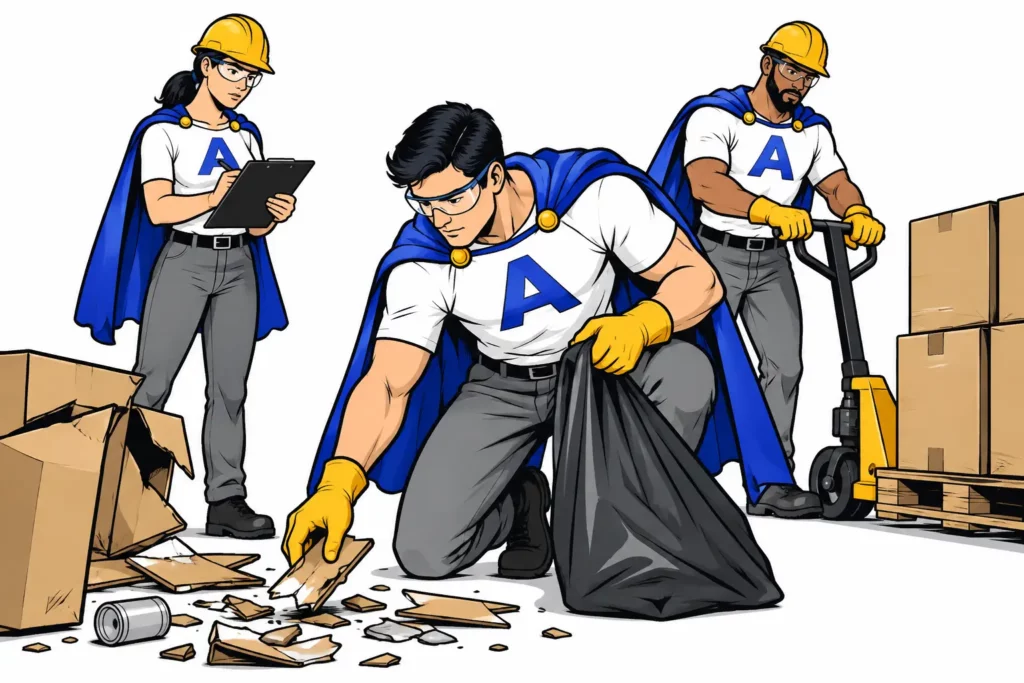
A pallet racking strike, a fall from a loading bay, a forklift collision or a fire alarm can stop a warehouse in minutes. The real test begins after the immediate danger has passed. Effective warehouse incident recovery protects injured people, preserves facts, meets reporting duties and prevents a rushed return to work from creating the next accident.
For employers operating in Germany, this is not simply an operational disruption. You remain responsible for safe working conditions under the Occupational Health and Safety Act (Arbeitsschutzgesetz, ArbSchG), even when an external provider supports you. A calm, documented response gives your team a route back to controlled work and gives you a sound basis for corrective action.
Warehouse incident recovery starts with control, not paperwork
In the first minutes, protect people and prevent the incident area from changing unnecessarily. Call emergency services where required, provide first aid and make sure trained first aiders are available. If a structure, machine, battery charging point or vehicle is involved, isolate the relevant energy source or access route only where this can be done safely.
Your first response should cover four practical actions:
- provide medical help and arrange emergency support where needed;
- stop nearby work and keep unauthorised people away from the area;
- secure vehicles, equipment and affected stock without disturbing evidence unnecessarily; and
- appoint one person to coordinate information, decisions and communication.
A warehouse manager may need to close one aisle, one loading bay or the entire facility. The proportionate choice depends on the hazard. A minor cut in a packing area does not necessarily require a site-wide stop. A damaged rack upright, an unstable load or a suspected electrical fault can affect a much wider area than the point where the event occurred.
Do not let production pressure dictate the boundary. If a forklift has struck racking, for example, the question is not only whether the driver is unhurt. You need to establish whether the racking remains stable, whether adjacent bays are affected and whether stock can be removed safely. The relevant area should remain closed until a competent inspection has taken place.
Separate emergency response from investigation
People sometimes delay action because they believe an investigation must be completed first. It does not. Emergency response, medical care and stabilising the workplace come first. Investigation follows as soon as the scene is safe.
Record the time, location, people involved, work being performed, equipment used and immediate actions taken. Take photographs where appropriate and retain relevant records, such as forklift pre-use checks, maintenance reports, training records, shift allocations and CCTV in line with your data protection arrangements. Speak to witnesses promptly, preferably separately, while the sequence is still clear.
The purpose is not to find a person to blame. It is to understand the conditions that allowed the event to happen. A driver may have made an error, but that does not end the enquiry. Consider pedestrian routes, speed controls, visibility, lighting, supervision, workload, damaged equipment, layout changes and whether training reflected the task actually being performed.
This distinction matters in warehouses because incidents are rarely caused by one factor alone. A delivery schedule may have increased traffic. A temporary worker may not have received a site induction. Damaged floor markings may have made a segregation rule difficult to follow. Recovery becomes useful only when it addresses these underlying conditions.
Meet reporting duties early and accurately
An internal incident record is needed for every relevant event, including near misses that reveal a serious hazard. Some accidents also require a statutory accident report (Unfallanzeige) to the accident insurance institution (Berufsgenossenschaft, or BG). In general, this applies where an occupational accident leads to death or an employee is unable to work for more than three calendar days. The report is normally submitted within three days of learning of the accident.
Serious events may also trigger contact with other authorities, depending on the circumstances, location and type of incident. Do not assume that a hospital report, insurer communication or internal email fulfils every employer duty. Preserve copies of submissions and keep a clear record of when decisions were made.
If the BG sends a deficiency notice after an accident or inspection, treat it as a structured correction task. Read each requested point carefully, assign responsibility, set realistic completion dates and collect evidence of the work completed. A generic statement that you have “reviewed safety” is rarely as helpful as updated documents, inspection evidence, photographs, training attendance and clear site controls.
Where an employee has been injured, involve the company doctor (Betriebsarzt) where occupational health input is appropriate. The company doctor can support decisions around workplace health risks and safe return arrangements, while confidentiality around medical information must be respected. The operational team needs to know any necessary restrictions, not an employee’s private diagnosis.
Reassess the work before restarting it
The incident should trigger a review of the relevant risk assessment (Gefährdungsbeurteilung). This is not an exercise in rewriting a document after the fact. Compare the planned controls with real work on the warehouse floor. Were they suitable, communicated, available and followed? If they were not followed, ask why.
For a vehicle incident, the review may cover traffic routes, crossing points, reversing rules, high-visibility clothing, visitor controls, shift handovers and the separation of pedestrians from powered industrial lorries. For a rack incident, consider loading limits, impact protection, inspection frequency, damage reporting and whether staff understand the stop-and-report rule.
The occupational safety specialist (Fachkraft für Arbeitssicherheit, or SiFa) should help you turn findings into proportionate controls. This may include physical changes, revised work instructions, targeted training or further inspections. Under DGUV 208-043, racking requires regular inspection by a competent person, alongside visual checks carried out by trained warehouse staff. After an impact or visible damage, waiting for the next planned inspection may not be appropriate.
Equipment can require separate technical checks. Electrical equipment and installations may fall within DGUV V3 requirements, while work equipment duties can arise under BetrSichV. The correct response depends on what failed, what was exposed to risk and whether the equipment remains safe to use. Do not restart a damaged forklift, loading dock leveller or charging installation merely because it appears to work.
Use a three-step recovery plan
A good recovery plan makes ownership visible. It should not disappear into a long incident report that nobody uses on the next shift.
1. Make the area safe
Confirm that immediate hazards have been removed or isolated. Obtain competent inspection where racking, lifting equipment, electrical systems, fire protection or building elements may have been affected. Clearly mark any restrictions and brief supervisors before work resumes.
2. Correct the causes
Translate investigation findings into named actions. A revised traffic route needs signs, floor markings, a communication plan and a date for checking whether it works. Training needs to reach the employees, agency staff and supervisors who perform or oversee the task. A new rule that exists only in a folder is not a control.
3. Verify and sustain the change
Set a review date and check the practical result. Observe work, speak to employees and review whether near misses, damage reports or unsafe shortcuts continue. If the measure is not working, adjust it. Recovery is complete when the safer method is operating in practice, not when the corrective action list is marked closed.
Bring people into the recovery process
Employees often know where workarounds have become normal. Invite that information without turning the discussion into a disciplinary hearing. Supervisors also need clear authority to stop unsafe work, especially where delivery pressure or a backlog creates incentives to take shortcuts.
Training after an incident should be specific. Repeating a generic annual slide deck rarely addresses a reversing collision or a racking overload. Use the actual task, equipment and routes involved, while avoiding unnecessary disclosure of personal details about anyone injured.
For businesses with the required structure, the occupational safety committee (Arbeitsschutzausschuss, or ASA) is a useful place to review trends, actions and responsibilities. It brings employer, employee, occupational safety and occupational health perspectives together. A serious incident should inform wider safety management, not remain an isolated operational problem.
Captain Safety can support employers through the full corrective journey: site inspection, risk assessment review, occupational safety specialist input, accident documentation, training and follow-up checks. If you are facing a BG letter, an accident report or uncertainty about reopening an affected area, request a quote for practical support tailored to your site.
The strongest recovery does more than get the warehouse moving again. It gives your people confidence that when something goes wrong, you will stop, investigate, fix what matters and make the next shift safer than the last.