
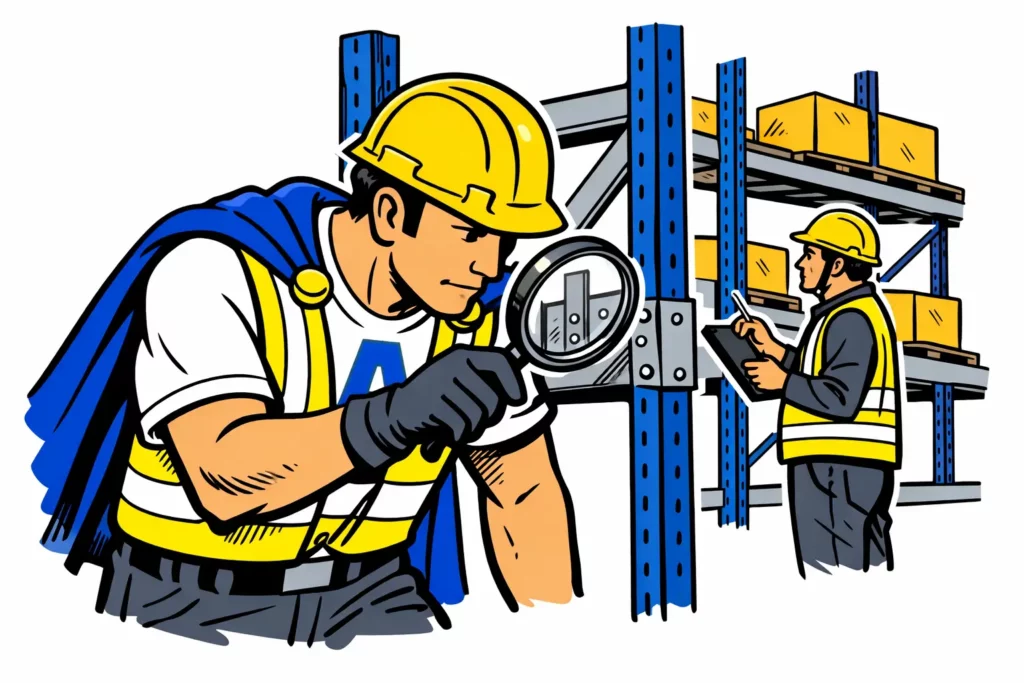
A forklift impact can look insignificant at the end of a busy shift. A bent upright, displaced beam or missing locking pin can then remain unnoticed until the load pattern changes and the risk becomes far more serious. Knowing how to inspect warehouse racking gives you a practical way to find these issues before they affect people, stock or operations.
For employers operating a warehouse in Germany, racking checks are not simply good housekeeping. They form part of your wider duty to provide safe work equipment and manage workplace risks. The goal is straightforward: identify damage early, take unsafe bays out of use where necessary, and keep a clear record that corrective action was taken.
Why warehouse racking inspections matter
Pallet racking carries substantial loads, often close to people, forklift routes and picking areas. Unlike a visibly broken pallet, a damaged rack can continue to be used for days or weeks. That does not mean it remains safe.
Germany’s Occupational Health and Safety Act (Arbeitsschutzgesetz, ArbSchG) requires employers to assess workplace risks and take suitable protective measures. The Industrial Safety and Health Ordinance (BetrSichV) also requires work equipment to be maintained and inspected according to the risks involved. For storage systems, DGUV 208-043 provides practical guidance on the safe operation and inspection of racking.
The inspection regime should match the equipment, its condition and how intensively it is used. A high-throughput warehouse with frequent forklift movements needs closer attention than a lightly used archive store. Your risk assessment (Gefährdungsbeurteilung) should set out the appropriate approach.
Who should inspect warehouse racking?
Racking inspection works best at three levels. Warehouse staff perform regular visual checks as part of their daily work. A trained nominated person carries out formal internal inspections, commonly at weekly intervals. At least once a year, an expert inspection should be completed by a competent person with the knowledge and experience to assess the racking system properly.
A competent person (befähigte Person) must understand the relevant racking design, loading principles, damage criteria and inspection requirements. This is not automatically the warehouse manager or the most experienced forklift driver. They need suitable training and practical competence for the system being assessed.
Your occupational safety specialist (Fachkraft für Arbeitssicherheit, or SiFa) can help determine inspection intervals, integrate findings into your risk assessment and make sure responsibilities are clear. The employer remains responsible for ensuring that inspections happen and defects are corrected.
Prepare before you start the inspection
Do not begin with a clipboard and hope for the best. First, obtain the racking layout, manufacturer information, load notices and records of previous inspections or repairs. Check whether the displayed load signs match the actual configuration. A rack altered with extra levels, different beams or new pallet types may no longer match its original load calculation.
Plan the inspection when aisles can be accessed safely. If you need to enter an area near forklift traffic, control vehicle movements and make sure colleagues know the inspection is taking place. Good lighting matters, especially around upright frames, beam connections and the rear of double-deep racking.
Take clear photographs of defects and identify the exact aisle, bay and level. A finding without a location is difficult to repair and even easier to forget.
How to inspect warehouse racking step by step
Start with the surrounding area
Walk each aisle before examining individual components. Look for poor housekeeping, loose wrapping, damaged pallets, obstructions and stock protruding into traffic routes. These conditions may not be structural defects, but they increase the chance of a collision or an unstable load.
Check that rack protection is present where vehicles can strike uprights. End-of-aisle guards and upright protectors must themselves be secure and undamaged. Protection that has shifted after an impact may conceal damage to the upright behind it.
Also look at floor condition and anchoring. Cracked concrete, loose base plates or missing anchors can affect rack stability. Water damage, corrosion and accidental building alterations can be relevant, particularly in loading areas, chilled stores and older premises.
Examine uprights, beams and connections
Pay close attention to upright frames. Look for dents, bends, twists, buckling and damage around the first beam level, where forklift impacts are common. Compare both sides of an aisle. A difference in alignment can reveal a problem that is less obvious when viewed from one direction.
Inspect beams for bending, dents and signs that they have been overloaded. Check beam connectors and locking devices. Every beam should be fully seated and secured with the intended safety pins or clips. Missing or improvised fixings require action, even if the beam appears stable.
Do not straighten a damaged upright or beam in-house unless the system manufacturer has expressly permitted a defined repair method. Unauthorised straightening, welding or drilling can change the load-bearing properties of the component. Replacement with compatible, approved parts is generally the safer route.
Check loading and use
Racking can be structurally sound and still be used unsafely. Confirm that pallets are not damaged, unsuitable or overhanging beams. Loads should be evenly placed, stable and within the load limits shown on the rack signage.
Look for changes in use. Heavy goods may have replaced lighter stock, pallet dimensions may have changed, or staff may now access locations with handling equipment that was not considered in the original layout. These changes should trigger a review of the risk assessment and, where needed, a check with the racking supplier or a competent inspector.
Verify that employees know the reporting route. A driver who clips an upright must report it immediately, not decide independently that the rack is still usable. Training should make this expectation clear and practical.
Classify defects and act without delay
A useful inspection report does more than say that damage exists. It records the location, type of defect, risk level, photographs, immediate controls, responsible person and repair deadline.
Where there is a serious risk of collapse or injury, unload the affected bay, isolate it physically and prevent reuse until it has been assessed and repaired. Use visible barriers and clear signs. A verbal warning is not a reliable control in a busy operation.
Less severe defects may allow controlled temporary use, but only where a competent person has assessed the risk and specified what must happen next. This is where businesses can make costly mistakes: continuing to load a damaged rack because a repair is scheduled is not the same as managing the risk.
Keep the repair evidence with the inspection record. If components are replaced, record what was fitted, who completed the work and when the bay returned to service. Reinspect the area after repair rather than assuming the job is complete.
Set a racking inspection schedule that works
A workable programme is more valuable than an impressive policy that no one follows. Give daily users a simple route for reporting impacts and visible defects. Nominate a trained internal inspector for regular documented checks. Arrange the independent annual expert inspection and review findings with your operational team.
The frequency of internal checks depends on your site. Increased checks may be sensible where there is heavy forklift traffic, a history of impacts, agency staff, frequent layout changes or high-value loads. Your accident insurance institution (Berufsgenossenschaft, or BG) may also expect evidence that your inspection arrangements reflect actual warehouse risks.
Store reports, photographs, repair records and training evidence together. They support safer decisions at the site and help demonstrate that you have a controlled process if an authority, customer or insurer asks questions.
Turn findings into an ongoing safety process
Captain Safety can support employers from an on-site racking inspection through defect management, updated risk assessments and ongoing annual review. The process is designed to be clear:
- Inspect and identify: assess the racking, its use and the immediate risks on site.
- Correct and document: prioritise defects, define practical controls and build a defensible record.
- Review and maintain: establish repeat inspections, employee reporting and training that keep standards in place.
If you have received a deficiency notice, suffered an impact incident or are opening a new warehouse, seek qualified support early. It is usually easier to control a small defect than to explain why it remained in service.
Frequently asked questions
Is an annual racking inspection enough?
Usually, no. The annual inspection is an essential expert review, but it does not replace regular visual checks. Staff should report damage immediately, and a trained internal person should inspect the racking at an interval suited to your operation, often weekly.
Can warehouse staff repair damaged racking?
Only where the repair is authorised, suitable components are used and the work is carried out by competent people. Avoid makeshift repairs, straightening damaged load-bearing elements or fitting incompatible parts. These actions can make the system less safe and complicate later inspection.
What should happen after a forklift strikes a rack?
Stop and assess the affected area promptly. The driver should report the impact, and a trained person should inspect the upright, beam connections, protection and anchoring. Where the damage may affect stability, unload and isolate the bay until a competent assessment confirms the next action.
A safer warehouse is built through the small decisions made after every near miss, impact and inspection finding. Give your people a clear reporting route, give defects the attention they deserve, and your racking will support the operation rather than becoming its hidden weak point.