
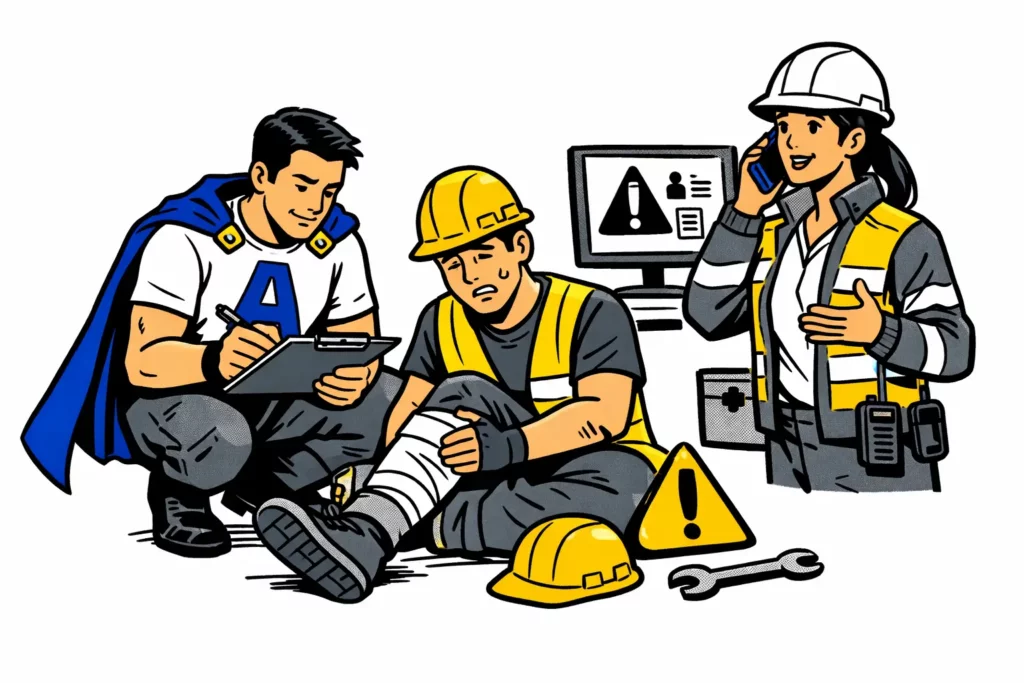
A forklift clips a pedestrian. An employee slips on a wet entrance floor. A delivery driver is injured while travelling between sites. In each case, the first priority is the person involved. But knowing how to report workplace accident cases properly is the next essential task for the employer. In Germany, a late, incomplete or poorly documented report can create avoidable problems with your statutory accident insurer and leave the underlying hazard uncorrected.
The right response is not to treat reporting as paperwork to finish after the fact. It is the start of a structured safety response: care for the injured person, preserve clear facts, notify the correct body within the deadline, investigate what happened and prevent a repeat.
How to report a workplace accident: the first actions
Deal with the emergency before the administration. Provide first aid, call emergency services where needed and make the area safe without putting anyone else at risk. If machinery, a vehicle, racking or an electrical installation may have contributed, take it out of use until a competent person has checked it.
Record the incident promptly in your first-aid documentation (Verbandbuch). This should capture the injured person’s name, the date and time, the place, the nature of the injury, the first-aid measures provided and the name of the first aider. A short entry made on the same day is usually far more reliable than a reconstructed account weeks later.
Ask for factual accounts from the injured employee and witnesses while details are fresh. Keep the questions neutral. Establish what happened, where it happened, what work was being carried out, which equipment or substances were involved, and what immediate conditions may have played a part. Photographs, CCTV retention, delivery records and equipment details may also be useful, provided you handle personal data appropriately.
Do not start by deciding who is at fault. Your task is to establish the facts and control the risk. A blame-focused process discourages reporting and can hide the operational weakness that caused the incident.
When an accident report is legally required
German statutory accident insurance is governed principally by the Seventh Book of Social Code (Sozialgesetzbuch VII, or SGB VII). As a general rule, you must submit an accident report when an insured person dies or is unable to work for more than three calendar days because of a work-related accident.
The report must normally reach the relevant statutory accident insurance institution (Berufsgenossenschaft, or BG) within three days of you learning about the accident. The day of the accident is generally not counted when calculating the absence period. Because the reporting threshold and deadlines are legal duties, do not wait for every internal question to be resolved before acting.
A work accident (Arbeitsunfall) can include an event at your site, while carrying out work elsewhere, or during an authorised business activity. A commuting accident (Wegeunfall) may also fall within statutory accident insurance, although the facts matter. A direct journey between home and the usual workplace is treated differently from a private detour.
Not every cut, bruise or near miss triggers the formal accident report. It should still be documented internally. Near misses are particularly valuable because they show where harm could have occurred without an injured person having to pay the price first.
For fatal, severe or multiple-injury events, contact the relevant accident insurance institution immediately by telephone as well as making the formal report. The institution may want to attend, advise on the next steps or begin its own investigation. Preserve the scene where practical and safe to do so, but never delay emergency care.
Complete the report with evidence, not assumptions
Most accident insurance institutions provide a digital accident reporting route or their own form. Use the form specified by your insurer and complete it carefully. The report commonly asks for employer and employee details, the date, time and place, the accident sequence, injury information, medical treatment and expected absence.
Describe events in plain, observable language. “Employee slipped while carrying two boxes on a wet floor near the loading entrance” is more useful than “employee was careless”. If the cause is not yet known, say so and explain that the investigation is continuing. Do not invent certainty simply to complete a form.
Where a works council is in place, include it in the reporting process as required. Keep a copy of the submitted report, supporting evidence and your internal investigation record. These documents should be stored securely, with access limited to people who need them for safety, employment or insurance purposes.
The employee may need treatment from an accident insurance doctor (Durchgangsarzt, or D-Arzt), depending on the injury and treatment required. Make sure the employee knows that the injury happened in connection with work so the medical provider can record the circumstances correctly. Your role is to support a clear route to treatment, not to make medical decisions.
Investigate the cause before work returns to normal
Submitting the report does not close the matter. The Occupational Health and Safety Act (Arbeitsschutzgesetz, ArbSchG) requires employers to identify hazards and take suitable protective measures. An accident is a clear signal that your existing controls need testing against reality.
Start with the risk assessment (Gefährdungsbeurteilung) for the activity involved. Was the hazard identified? Were controls in place and workable? Had staff received clear instruction? Was equipment maintained and inspected? Were staffing levels, time pressure, layout, housekeeping or supervision part of the picture?
The answers can be uncomfortable, particularly in fast-growing businesses. A warehouse may have a traffic plan on paper but no marked pedestrian routes. A retail team may have been trained at induction but not briefed when the stockroom layout changed. An office may have suitable display-screen guidance yet overlook a recurring trip hazard created by temporary cabling.
Corrective action should match the risk. In many cases, a physical or organisational change is stronger than relying on people to be more careful. Separate pedestrians from forklift routes, repair the floor, change a storage layout, add guarding, revise a process or schedule a formal inspection. Then update instructions and train affected employees on the new arrangement.
Assign clear responsibilities after a reportable accident
The employer remains responsible for workplace safety, even when tasks are delegated. That means someone must own the report, evidence, corrective actions and follow-up dates. In a smaller company this may be an operations manager or managing director. In a larger business it may involve HR, facilities, line management and an internal HSE contact.
An occupational safety specialist (Fachkraft für Arbeitssicherheit, or SiFa) can help examine the technical and organisational causes, revise the risk assessment and track controls to completion. A company doctor (Betriebsarzt) can advise on occupational health aspects, return-to-work measures and whether wider health risks need attention.
This is also the moment to check connected compliance duties. If an accident involved work equipment, confirm whether the required inspection under the Operational Safety Ordinance (Betriebssicherheitsverordnung, BetrSichV) is current. If hazardous substances were involved, review the substance assessment, operating instructions and employee training. If the incident revealed gaps in emergency arrangements, test first-aid provision, evacuation arrangements and fire protection responsibilities.
A practical three-step response
A dependable process keeps the pressure manageable:
- Protect people and record facts. Give first aid, secure the area, document the incident and retain evidence.
- Notify the right organisation on time. Check the absence threshold, submit the accident report to the relevant accident insurer and escalate serious events immediately.
- Fix the conditions that allowed it. Investigate the cause, update the risk assessment, implement controls and verify that they work in practice.
For employers operating across Germany, the exact accident insurance institution may differ by sector and activity. The core duty does not: report qualifying accidents correctly, cooperate with the insurer and turn the findings into practical prevention.
If you have received a request for information, a deficiency notice or a follow-up question after an accident, bring in competent support early. Captain Safety can help organise the evidence, review your safety documentation, coordinate corrective measures and establish the ongoing arrangements that make your next response calmer and stronger.
A workplace accident is always disruptive. Handled with care, it can also become the point at which a hidden weakness is found, corrected and prevented from harming somebody else.