
A risk assessment that sits unchanged in a folder can quickly stop reflecting the workplace your employees actually use. So, what triggers risk assessment review? In Germany, the answer is usually a meaningful change in working conditions, evidence that existing controls are not working, or new knowledge about a hazard. The aim is not paperwork for its own sake. It is to make sure your risk assessment (Gefährdungsbeurteilung) remains a practical basis for safe work.
For employers, this matters because the Occupational Health and Safety Act (Arbeitsschutzgesetz, ArbSchG) requires risks to be assessed and protective measures to be reviewed for effectiveness. A review is not necessarily a complete rewrite every time. Sometimes a focused update, new instruction and documented corrective action are enough. It depends on what has changed and how far that change affects people, equipment and processes.
What triggers a risk assessment review?
The central trigger is a change that could introduce a new risk or alter an existing one. A growing business may move office, add warehouse capacity, bring in new machinery or ask employees to work differently. Each can make an earlier assessment incomplete.
A review is also needed when you learn that a safeguard is ineffective. That knowledge may come from an accident, a near miss, employee feedback, a maintenance finding, a company doctor (Betriebsarzt) observation or an inspection by the accident insurance institution (Berufsgenossenschaft, or BG). Waiting for an annual diary date is rarely the right response where there is a clear warning sign.
A new site, layout or work area
Opening a German office, shop, workshop or warehouse is a common compliance trigger. The physical environment changes the hazards: escape routes, traffic routes, storage heights, lighting, electrical installations, workstations and fire protection arrangements all need consideration.
The same applies when you reorganise an existing site. Moving racking, creating a packing area, changing pedestrian routes or placing desks in a former storage room can affect fire safety, access, manual handling and display screen work. An assessment prepared for the old layout cannot simply be assumed to cover the new one.
New equipment, substances or technology
New equipment creates a review point before it is put into normal use. This includes machinery, lifting aids, racking, mobile equipment, electrical devices and charging stations. The review should consider intended use, foreseeable misuse, training needs, maintenance and any statutory inspection requirements.
Hazardous substances deserve particular care. A new cleaning chemical, adhesive, aerosol, battery material or laboratory product can change exposure risks and emergency arrangements. The assessment should be supported by current safety data, suitable storage and clear operating instructions. The Hazardous Substances Ordinance (Gefahrstoffverordnung, GefStoffV) and relevant Technical Rules for Hazardous Substances (TRGS) may shape what is needed.
Digital change can be a trigger too. New software that increases screen time, remote monitoring that changes work pace, or automated systems that alter employees’ tasks may create ergonomic or psychosocial risks. Risk assessment is about work conditions, not just visible physical hazards.
Changed people, tasks or working hours
A risk assessment should be reviewed when the workforce or work organisation changes in a way that affects exposure. Examples include a rapid increase in headcount, agency workers joining a warehouse team, younger workers starting employment, employees returning after a long absence, or a new shift pattern.
Not every individual personnel change requires a new document. However, you must check whether the existing measures remain suitable for the people doing the work. Language needs, competence, supervision and vulnerable groups can all affect the result. For an international workforce, training and instructions must be understood in practice, not merely issued in German or English without verification.
Changes to home working and hybrid work can also require attention. Employers retain duties for work equipment, display screen arrangements and work-related stress, even though the practical scope of assessment differs from a controlled workplace.
Accidents, near misses and health concerns
A workplace accident is a clear reason to review the relevant assessment immediately. The review should look beyond the direct event. Was the task assessed correctly? Were protective measures available, maintained and followed? Was the instruction adequate? Did workload, supervision, layout or equipment condition contribute?
A near miss deserves the same curiosity. It is often the most useful warning your organisation will receive because no one has yet been harmed. Recording and investigating near misses gives you a chance to correct a weak control before it becomes an accident report.
Patterns of sickness absence, repeated discomfort complaints or reports of stress may also reveal a risk assessment gap. The company doctor and occupational safety specialist (Fachkraft für Arbeitssicherheit, or SiFa) can help distinguish isolated issues from a work-related pattern that needs action.
Inspections, deficiencies and new requirements
A letter, deficiency notice or visit from a BG often creates an urgent review point. The authority may identify missing documentation, inadequate training, unsafe equipment or incomplete appointments. Treat the finding as a prompt to examine the wider system, not just the individual item named in the letter.
New legal requirements, updated technical rules, manufacturer information or recognised safety knowledge can also change what is reasonably required. This does not mean every external update demands a wholesale reassessment. You should assess relevance to your site, activities and employees, then document the decision and any resulting measures.
Annual review is useful, but it is not the only rule
Employers often ask whether German law sets one universal annual renewal date. For general risk assessments, there is no single yearly interval that suits every workplace. ArbSchG requires employers to assess working conditions and review the effectiveness of measures. The practical frequency depends on the level of risk, how quickly operations change and any specific rules that apply to equipment or activities.
An annual management review is still sensible. It creates a planned opportunity to check that assessments, training records, inspections, emergency arrangements and action lists still match operations. But it must not replace event-driven reviews. A warehouse expansion in May should be assessed in May, not held over until a scheduled December review.
Some obligations have their own intervals. Electrical equipment inspection under DGUV V3, racking inspection expectations under DGUV 208-043, fire protection checks and equipment inspections under the Industrial Safety and Health Ordinance (Betriebssicherheitsverordnung, BetrSichV) follow their own risk-based requirements. Their findings should feed back into the main risk assessment.
How to review the assessment properly
A useful review starts at the place where work happens. Walk the area, observe the task, speak to employees and compare daily practice with the written assessment. If the document says pedestrian routes are clear but pallets regularly sit in them, the real control has failed.
Then identify what has changed, who may be affected and whether current controls eliminate or reduce the risk sufficiently. Update the assessment, assign corrective actions with owners and dates, and record how effectiveness will be checked. Where new risks require instruction, provide it before employees carry out the changed work.
Three steps keep the process manageable:
- Inspect and identify – Review the changed activity, workplace, equipment or incident with the people who know the work.
- Correct and document – Set proportionate controls, update the risk assessment and retain evidence of decisions, instructions and inspections.
- Check effectiveness – Confirm that actions are completed and working in practice, then revisit them if conditions change again.
External support is particularly valuable when several duties overlap, such as a new warehouse involving racking, forklift traffic, hazardous substances, fire safety and occupational health. Your safety specialist and company doctor should be involved according to the needs of the business and the support framework under DGUV V2.
Who is responsible for keeping reviews current?
The employer remains responsible for occupational health and safety, even when tasks are delegated to managers or external specialists. A facilities manager may coordinate inspections, an HR lead may arrange training, and an operations manager may implement controls. Those roles can make the work happen, but they do not remove the employer’s duty to ensure it happens.
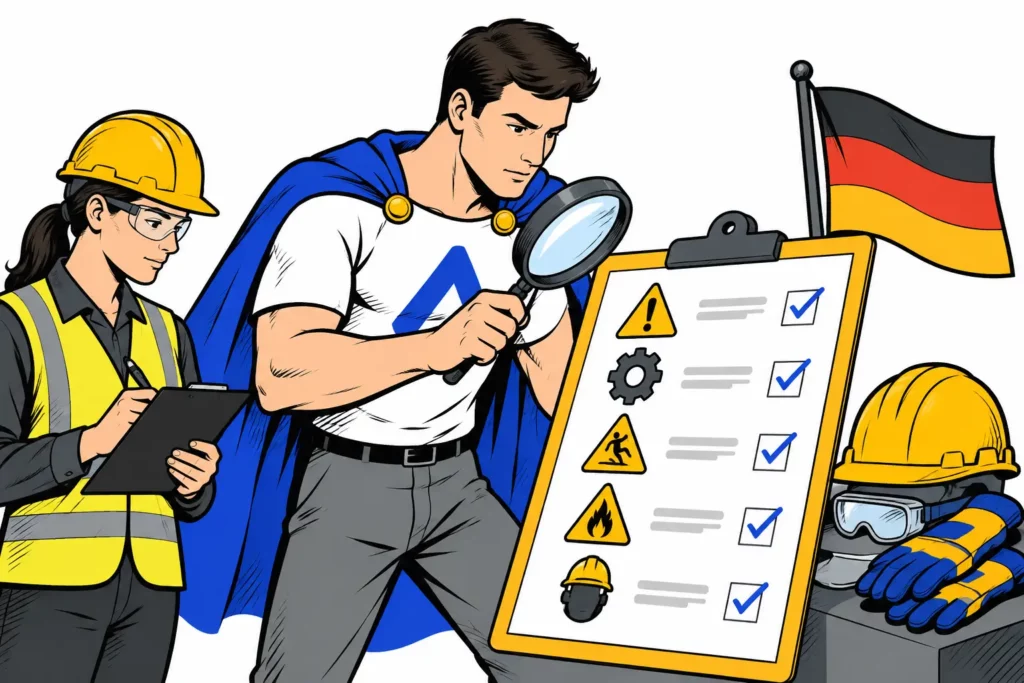
For businesses without an in-house HSE team, Captain Safety can inspect the workplace, structure the assessment, coordinate corrective actions and support ongoing reviews across Germany. Think of it as bringing in health and safety superheroes with clipboards, technical knowledge and a clear action plan.
A review should lead to safer work
The best risk assessment review ends with visible improvements: a safer route through the warehouse, clearer instructions, suitable equipment, corrected storage or better support for employees. Keep the document current, but focus on the work it changes. When a trigger appears, act early and turn it into a practical safety improvement rather than a last-minute compliance problem.