
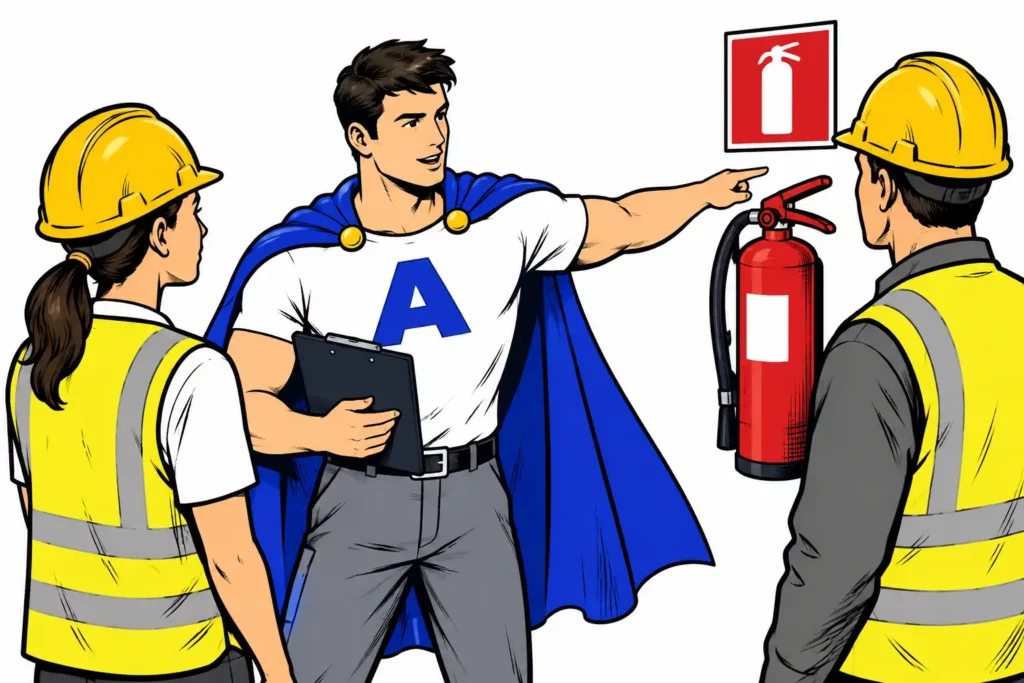
A fire alarm is not the moment to find out that nobody knows who should check the toilets, guide visitors outside or report to the fire service. If you are asking how to appoint fire wardens, the practical answer starts before you choose names: assess the fire risks at each workplace, decide how many trained people you need, and make their duties clear.
For employers operating in Germany, the role commonly called a fire warden is usually the fire safety assistant (Brandschutzhelfer). The title can sound straightforward, but the appointment needs to reflect your actual premises, workforce and operating hours. A small office with one daytime team needs a different arrangement from a warehouse with shift work, contractors and battery-charging areas.
What a fire warden does in Germany
A fire safety assistant supports the employer’s fire safety arrangements. Their principal role is to help employees evacuate safely and, where this can be done without personal danger, take initial action with available firefighting equipment. They are not expected to become firefighters or enter smoke-filled areas.
Typical duties may include directing people to escape routes and assembly points, checking allocated areas if it is safe to do so, helping visitors or people who need assistance, and reporting relevant information to the emergency services. They should also understand the site alarm, evacuation plan, extinguishers and any specific hazards.
Do not confuse this role with a fire safety officer (Brandschutzbeauftragter). A fire safety officer has a broader, more specialist coordinating role and may be required because of the building, business activity, insurer expectations or fire protection concept. A fire safety assistant is an employee trained to assist during an incident. Some businesses need both roles, while many lower-risk workplaces initially need trained fire safety assistants supported by a sound risk assessment.
The legal basis for appointing fire wardens
The Occupational Health and Safety Act (Arbeitsschutzgesetz, ArbSchG) requires employers to take necessary measures to protect employees’ safety and health. That includes organising emergency measures for fire, evacuation and first aid. Your risk assessment (Gefährdungsbeurteilung) is where you establish what those measures must look like in your workplace.
The Technical Rule for Workplaces ASR A2.2 gives practical guidance on measures against fires. It states that employers should provide a sufficient number of trained fire safety assistants. As a general starting point, at least 5% of employees should be trained. That figure is not a universal finish line. The number may need to be higher where there are multiple floors, large sites, shift patterns, regular lone working, public access, high staff turnover or elevated fire risks.
Your building’s fire safety rules, landlord requirements, fire authority conditions and the expectations of the relevant accident insurance institution (Berufsgenossenschaft, or BG) can also affect the arrangement. The duty remains with you as employer, even when tasks are delegated to a facilities manager, site lead or external specialist.
How to appoint fire wardens: a practical process
The strongest appointments are based on a short, documented process rather than a generic percentage copied from another site. The following three steps make the decision clear and defensible.
1. Inspect the workplace and assess coverage
Start with a site walk-through. Look at the number of people on site, the layout, escape routes, alarm points, extinguishers, assembly areas and the presence of visitors or contractors. Consider what changes outside ordinary office hours. If your trained people all work Monday to Friday, they do not provide coverage for a Saturday retail shift or a night warehouse operation.
Then assess fire hazards. Kitchens, server rooms, workshops, storage areas, flammable substances, charging stations and packaging operations can all alter the level of preparation required. People also matter: a workforce spread across several units, employees with mobility needs, or colleagues who do not speak the same first language may require a more considered evacuation plan.
Record why you chose the number of fire safety assistants. A percentage is useful as a baseline, but coverage during absence, holidays, sickness and shift changes is the real test. You may need deputies in each area so that the plan still works on an ordinary, imperfect day.
2. Choose suitable employees and confirm the appointment
Select people who are regularly present, reliable under pressure and familiar with the area they cover. They do not need to be managers. In fact, appointing only senior staff can create a gap if they are often travelling or working in meetings away from the floor.
Before appointing someone, explain the task, training requirement and expected limits of the role. Fire safety assistants should never be put in a position where they feel required to tackle a fire that is too large or dangerous. Evacuation and personal safety always take priority.
Confirm the appointment in writing. The document should identify the employee, workplace or area, date of appointment, core responsibilities and the person they report to. Keep it proportionate, but specific enough that there is no doubt about who is assigned to which part of the site.
Make the appointments visible to relevant colleagues. This might mean including names in evacuation information, displaying them at safety noticeboards and informing reception or facilities teams. Avoid relying only on a list hidden in an HR folder.
3. Train, practise and keep records current
Appointed employees need suitable theoretical and practical instruction. Training should cover the principles of fire prevention, alarm and evacuation procedures, safe use of firefighting equipment, the limits of intervention and the specific hazards at your premises. Practical extinguisher training is particularly valuable because it turns a written procedure into a controlled response.
Training is not a one-off box to tick. Refresh it at appropriate intervals and whenever the workplace changes materially. A new warehouse layout, a move to larger premises, altered escape routes or a change in hazardous materials should trigger a review. Fire drills also reveal whether your chosen numbers and locations are realistic.
Keep records of appointments, training attendance, course content, evacuation drills, equipment checks and corrective actions. If a drill shows that an exit was blocked or an area was not checked, record what you changed and who owns the action. Good documentation gives you a practical management tool, not just a file for an inspection.
Common mistakes that leave gaps
The most frequent mistake is appointing exactly 5% of the headcount without checking who is actually available. Five trained employees may sound adequate, but it is not useful if four are on holiday and the fifth works in a different building.
Another is treating fire safety assistants as the entire fire protection system. They need working alarms, clear escape routes, appropriate equipment, employee instruction and an evacuation procedure behind them. No appointment letter can compensate for a locked emergency exit or staff who have never heard the alarm.
Businesses also overlook changes. A growing team, a new tenant, more stored goods or a new shift pattern can quickly make an old appointment list unsuitable. Review fire safety arrangements as part of your regular risk assessment review, not only after an incident or authority visit.
When external support helps
If you are opening a German site, responding to a deficiency notice or trying to bring several locations into line, an external review can save time and uncertainty. An occupational safety specialist (Fachkraft für Arbeitssicherheit, or SiFa) can help integrate fire safety assistants into the wider risk assessment, emergency organisation and employee training plan.
Captain Safety supports employers with site inspections, legally structured risk assessments, appointments, training and follow-up actions. The aim is practical coverage that works during a real evacuation, not a folder of documents that looks complete until the alarm sounds.
A well-chosen fire warden gives colleagues a calm, informed point of contact when seconds matter. Start with your site’s actual risks, appoint enough people for real-world coverage, and keep testing the plan as your business changes.