
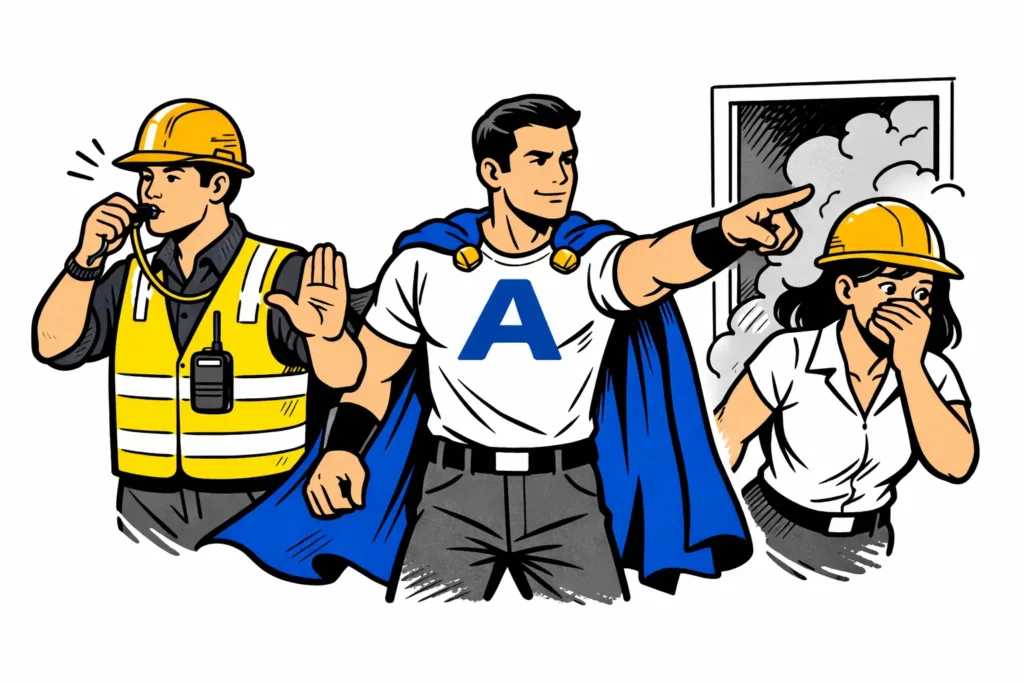
A fire alarm is not the moment for colleagues to debate which exit to use, collect laptops or search for a manager. Knowing how to conduct a fire drill gives people a calm, practised response before a real emergency puts them under pressure. For employers operating in Germany, it is also a practical part of meeting workplace fire protection duties.
A worthwhile drill tests more than whether everyone reaches the pavement. It reveals blocked escape routes, unclear responsibilities, visitors who do not know the site, alarms that cannot be heard in noisy areas and assembly points that are too close to the building. Treat it as a controlled test of your emergency arrangements, not a box-ticking exercise.
Start with your fire risk assessment
Your fire drill should follow your risk assessment (Gefährdungsbeurteilung). Under the Occupational Health and Safety Act (Arbeitsschutzgesetz, ArbSchG), you must identify workplace hazards, define suitable protective measures and check whether those measures work in practice. Fire risks can arise from electrical equipment, cooking areas, charging stations, flammable materials, hot work, storage layouts and the nature of your building.
The Workplace Ordinance (Arbeitsstättenverordnung, ArbStättV) also requires suitable arrangements for escape and rescue. The precise drill design depends on the site. A small office on one floor needs a different plan from a warehouse with shift workers, racking, loading bays and agency staff.
Before setting a date, review your escape and rescue plan, fire alarm arrangements, escape routes, emergency lighting, fire doors and assembly point. Confirm that routes are clearly marked, usable and free from stored goods. A route that looks acceptable on a drawing may be obstructed by deliveries, temporary equipment or locked doors in daily operation.
How to conduct a fire drill: plan the test
Choose a drill scenario that tests realistic conditions without creating avoidable risk. For a first drill at a new site, a straightforward daytime evacuation is sensible. Later exercises can test a different escape route, a shift change, a visitor-heavy period or a situation where a nominated fire warden is absent.
Decide whether the drill will be announced. An announced exercise is useful when employees are unfamiliar with the building, when you are introducing a new evacuation process or where an unannounced alarm could create confusion. An unannounced drill may provide a more realistic test, but it needs careful control. Consider vulnerable people, lone workers, public-facing operations, nearby tenants and any activity that cannot safely stop without preparation.
Tell the right people in advance. This may include building management, security, reception, neighbouring occupiers and the monitoring company connected to the fire alarm system. If the system automatically notifies the fire and rescue service, you must follow the agreed procedure for test mode. Never run a drill in a way that could trigger an unnecessary emergency response.
Assign clear responsibilities
People evacuate faster when they know who is coordinating. Your written plan should name a drill coordinator, fire wardens, reception or visitor coordinators, first aiders and people responsible for roll call. Give deputies for absences and shift patterns.
Fire safety assistants (Brandschutzhelfer) can support evacuation, but they are not expected to fight a fire at personal risk. Their role is to assist people, follow the emergency procedure and only use extinguishing equipment where this is safe, appropriate and within their training.
Reception needs a current visitor record. In warehouses and logistics sites, include drivers, contractors and temporary workers in the process. For employees who may need personal evacuation assistance, agree an individual plan before the drill. Do not assume that a colleague will simply be available to help.
Brief observers, not just participants
Assign observers at key points such as stairwells, exits, loading areas and the assembly point. They should record facts: when the alarm sounded, when people began moving, whether doors closed properly, whether anyone returned for belongings and whether a supervisor checked a designated area.
Avoid turning the exercise into a race. Evacuation time is useful evidence, but a quick exit achieved through running, crowding stairs or ignoring missing people is not a successful drill. The aim is safe, orderly evacuation and reliable accountability.
Run the evacuation safely
At the agreed time, activate the alarm or use the method set out in your emergency procedure. Staff should stop work, leave by the nearest safe route, close doors behind them where possible and proceed directly to the assembly point. They should not use lifts unless your specific evacuation plan says otherwise.
Fire wardens should sweep only areas that can be checked without entering danger. They must not delay their own escape or re-enter the building. A closed door, smoke, heat, an alarm condition or uncertainty about the fire location changes the situation immediately. In a real incident, the fire and rescue service takes control on arrival.
At the assembly point, managers or nominated persons should carry out roll call promptly. Record who is present, missing or known to be off site. Do not allow people to disperse before the coordinator has completed the check. If somebody is unaccounted for in a real emergency, that information is critical for the emergency services.
Only end the drill once the coordinator gives a clear all-clear. Employees should return in an orderly manner and normal operations should restart only when it is safe to do so.
Record what happened and correct it
A drill becomes valuable when its findings lead to action. Hold a short debrief immediately afterwards while observations are fresh. Ask practical questions: Could everyone hear and recognise the alarm? Did visitors understand what to do? Were escape routes clear? Did the roll call work? Did anyone use an unsuitable route or fail to reach the assembly point?
Document the date, scenario, participating areas, named coordinators, observations, evacuation timing where measured, identified deficiencies and corrective actions. Assign each action to an owner and deadline. Examples include replacing faded signage, moving stored materials, updating visitor procedures, appointing additional fire wardens or providing refresher instruction.
Update the risk assessment and emergency arrangements where the drill exposes a weakness. Evidence of an exercise without evidence of follow-up may raise further questions during an inspection by the accident insurance institution (Berufsgenossenschaft, or BG).
Set a frequency that matches your workplace
German law does not make every workplace identical, so avoid relying on a generic annual-drill rule without considering your actual risks. The right frequency depends on the building, workforce turnover, site changes, fire risks, shift arrangements and lessons from previous exercises.
Run additional drills when you open a new location, alter escape routes, introduce a new alarm system, expand storage, bring in large numbers of new staff or experience a fire-related incident. Training must also be repeated when procedures change. A warehouse with frequent temporary workers will usually need more active reinforcement than a stable, low-risk office.
When external support is useful
If your site has grown quickly or you have inherited incomplete documents, fire drill planning can expose wider gaps in fire protection. An occupational safety specialist (Fachkraft für Arbeitssicherheit, or SiFa) can help connect the drill to the risk assessment, employee instruction and practical site conditions. Where required, a fire safety officer (Brandschutzbeauftragter) can provide additional specialist coordination.
Captain Safety supports employers across Germany with site inspections, risk assessments, fire protection arrangements, employee training and documented corrective actions. This is particularly useful when you need English-language guidance while meeting German workplace safety duties.
Frequently asked questions
Must employees take part in a fire drill?
Employees should be instructed on the emergency procedures relevant to their work and take part in drills arranged for their area. You should also make suitable arrangements for visitors, contractors, remote workers attending the site and staff on different shifts.
Should a fire drill be announced?
It depends on the purpose and maturity of your arrangements. Announced drills help teach a new process safely. Controlled unannounced drills can later test whether instructions work in normal conditions. In both cases, inform parties who need to prevent false emergency call-outs.
What if someone refuses to leave during the drill?
Record the issue and establish why it happened. The cause may be unclear instruction, a manager setting the wrong example, a disability-related need or a belief that work cannot stop. Address the underlying issue through instruction, supervision and, where needed, an individual evacuation plan.
A well-run fire drill is one of the clearest ways to show employees that safety procedures are real. Plan it carefully, watch what actually happens and fix what the exercise reveals. That is how a routine alarm test becomes a safer workplace.