
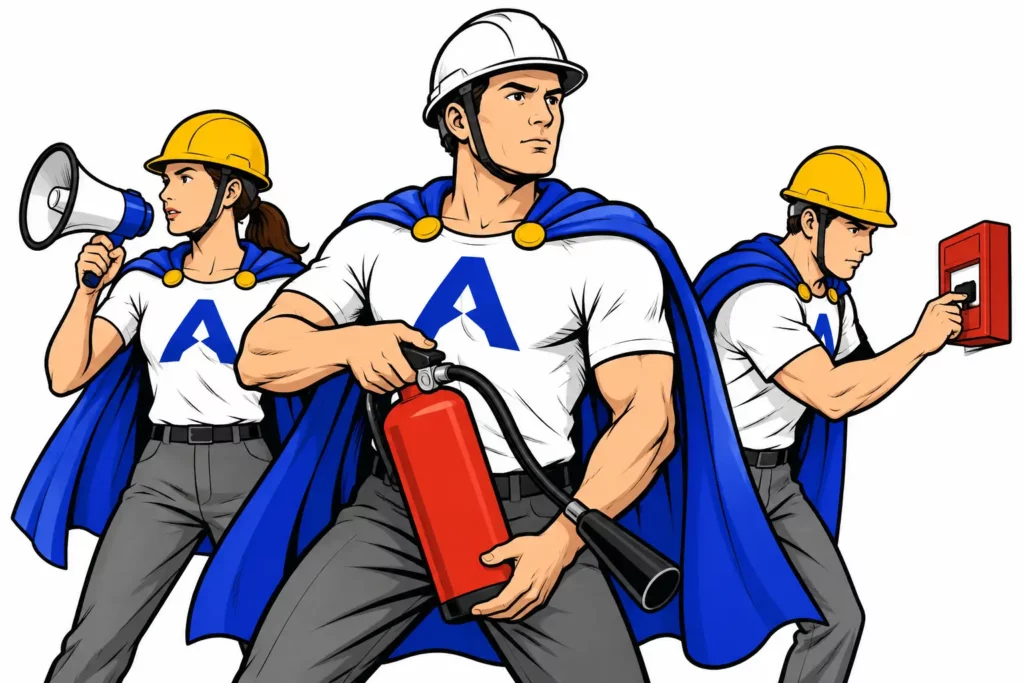
A landlord asks who your fire warden is. An accident insurance institution (Berufsgenossenschaft, or BG) requests your fire safety documentation. Or you are opening a German warehouse with 30 new employees. At that point, the question is direct: are fire wardens mandatory? In Germany, the answer is usually yes in practice, but the legal role and the number of people required are often misunderstood.
Are fire wardens mandatory in Germany?
German employers must appoint a sufficient number of employees to carry out fire-fighting and evacuation duties. This requirement comes from Section 10 of the Occupational Health and Safety Act (Arbeitsschutzgesetz, ArbSchG). It requires you to take account of the nature of the workplace, the activities performed and the number of people present.
The role most international employers mean by a fire warden is a fire safety assistant (Brandschutzhelfer). These are trained employees who can take initial action in a fire, use available extinguishing equipment where safe, and support an orderly evacuation.
The wording matters. German law does not simply prescribe one fire warden for every business or a fixed number based only on headcount. Instead, you must make a documented assessment of your own fire risks and provide suitable arrangements. For most workplaces, that leads to an obligation to train and appoint fire safety assistants.
The Technical Rule for Workplaces ASR A2.2 provides the practical benchmark. It generally assumes that at least 5% of employees should be trained as fire safety assistants. That is a starting point, not an automatic safe harbour. You must also ensure enough trained people are available during holidays, sickness, shift work and business travel.
Fire safety assistants and fire safety officers are different roles
A common compliance mistake is to treat every fire-related duty as the job of a single “fire warden”. In German workplace safety, two roles can be relevant, and they are not interchangeable.
A fire safety assistant is the operational role required to support fire-fighting and evacuation. The person needs practical instruction in the use of extinguishers and must understand the emergency arrangements at the site.
A fire safety officer (Brandschutzbeauftragter) has a broader, specialist role. This person helps coordinate organisational fire protection, reviews fire risks and can support measures such as fire protection rules, evacuation planning and communication with relevant parties. A fire safety officer is not required in every company by a single blanket rule. However, the role may be required by the building’s fire protection concept, conditions imposed by an authority, the nature of the operation, contractual requirements, or the outcome of your risk assessment.
For a small, low-risk office, trained fire safety assistants and clear emergency arrangements may be enough. A warehouse storing flammable substances, a production site, a large retail unit or premises open to the public may need more extensive fire protection organisation. The risk profile, not the job title alone, determines the answer.
How many trained fire safety assistants do you need?
Begin with the 5% benchmark in ASR A2.2, then test whether it reflects what happens at your site. If you employ 40 people in one office during normal hours, two trained assistants may be a reasonable initial calculation. If those two regularly work remotely, travel, or are absent at the same time, the arrangement is unlikely to work when it is needed.
You should consider four practical factors:
- the fire hazards created by your activities, equipment and materials
- the size, layout and escape routes of the premises
- the number of employees, visitors, contractors and other people present
- working hours, shifts, remote locations and foreseeable absences
Higher-risk work normally calls for more trained people. This may include workplaces with welding or other hot work, kitchens, charging areas for industrial vehicles, hazardous substances, extensive electrical equipment, or difficult evacuation routes. Employees who may need support to evacuate also need to be considered.
In multi-tenant buildings, do not assume the landlord’s arrangements meet your employer duties. The building operator may manage alarms, escape routes and shared equipment, but you remain responsible for the employees you employ and the work you organise. Clarify responsibilities in writing, then reflect them in your own risk assessment (Gefährdungsbeurteilung).
Training must be practical, not just a signed attendance sheet
A nominated employee is not automatically a trained fire safety assistant. ASR A2.2 expects instruction that includes practical familiarisation with fire-fighting equipment. A short online course may help employees understand theory, but on its own it will rarely demonstrate that a person can select and operate an extinguisher safely.
Training should cover the types of fire that may occur, the limits of initial fire-fighting, alarm and emergency procedures, escape routes, assembly points, and how to use the equipment provided. The most useful training is tailored to the actual workplace. A team at a logistics site faces different scenarios from a team in a serviced office.
There is no single universal legal interval that suits every employer for refresher training. You should review competence at suitable intervals and retrain when there are significant changes, such as a new site, new processes, new fire hazards, changed evacuation routes or a long gap since practical instruction. Keep training records that show who attended, what was covered, who delivered it and when it took place.
Your wider fire protection duties still apply
Fire safety assistants are one part of an emergency system. They do not replace fire risk controls or compensate for unsafe premises. Under ArbSchG, employers must take suitable measures for first aid, fire-fighting and evacuation, and must provide the necessary connections to external emergency services where required.
Your risk assessment should identify ignition sources, combustible materials, people at risk and the effectiveness of existing controls. It should then lead to clear actions. In practice, this often includes suitable extinguishers, unobstructed escape routes, emergency signage, evacuation information, defined assembly points and emergency drills where appropriate.
Employees must also receive workplace-specific safety instruction. They need to know what the alarm sounds like, where to go, whom to report to and why they should not attempt to fight a fire beyond their training or personal safety limits. The priority is always a safe evacuation. Fire safety assistants should only attempt initial fire-fighting if conditions allow it and there is no unacceptable danger.
What you should document
If an authority, insurer or BG asks about your arrangements, informal assurances are difficult to evidence. Keep your fire protection duties connected in one manageable set of records. That usually includes the fire-related section of the risk assessment, the number and names of trained fire safety assistants, training certificates or attendance records, equipment inspection records, employee instruction records and any evacuation drill findings.
Review these records after changes to the workplace. A move to a bigger unit, a new racking layout, a change in staffing pattern or new stored materials can alter both the fire risk and the number of people you need on site.
A practical route to compliance
Start by inspecting the workplace rather than choosing a number from a checklist. Identify fire hazards, evacuation conditions and the people who need to be covered across all working hours. Next, appoint and practically train enough fire safety assistants for the real operating pattern. Finally, document the decision, maintain the equipment and review the arrangement when conditions change.
If you have received a deficiency notice, are opening a new location or are unsure whether your existing appointments are sufficient, Captain Safety can help assess the site, organise the necessary measures and bring the documentation into order. The right arrangement is not the most elaborate one on paper. It is the one your people can rely on in the first minutes of an emergency.