
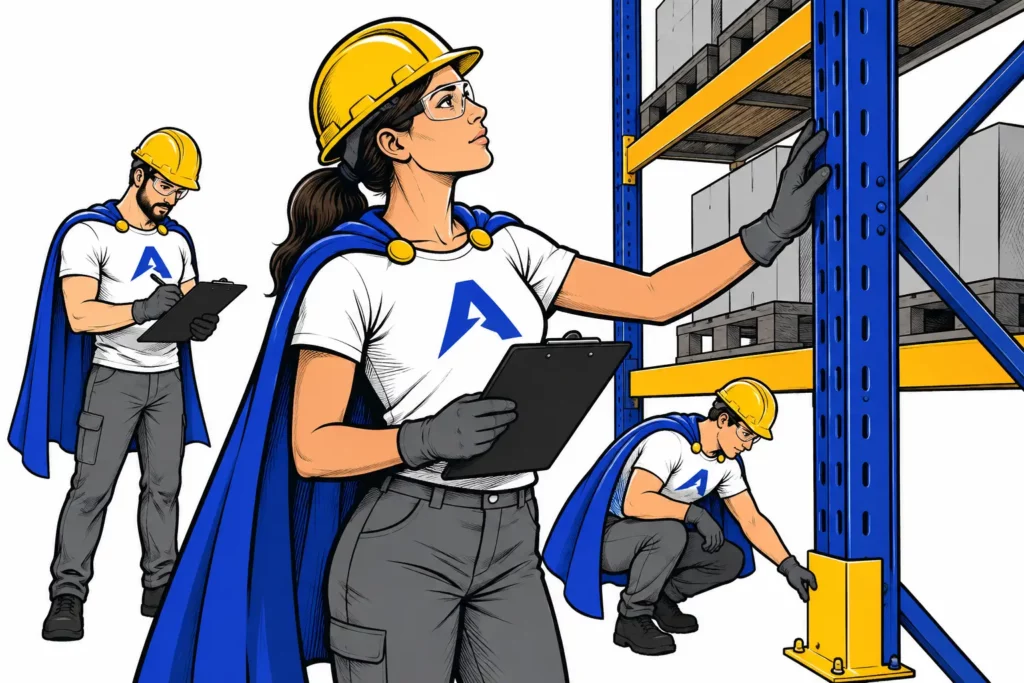
A bent upright, a missing beam locking pin or a forklift strike can turn a busy warehouse aisle into a serious risk within minutes. Racking inspection frequency is therefore not just an administrative question. It is how you find damage before a loaded pallet rack fails, stock falls or employees are put in danger.
For employers operating warehouses in Germany, the practical benchmark is clear: carry out regular visual checks, arrange a formal expert inspection at least annually, and act immediately when damage is found. Your precise inspection plan should reflect your risk assessment (Gefährdungsbeurteilung), the rack design, traffic levels and the likelihood of impact.
Racking inspection frequency in Germany
German workplace safety law requires employers to provide safe work equipment and maintain safe working conditions. The Occupational Health and Safety Act (Arbeitsschutzgesetz, ArbSchG) and the Ordinance on Industrial Safety and Health (Betriebssicherheitsverordnung, BetrSichV) provide the wider legal framework. For storage systems, DGUV 208-043 and DIN EN 15635 set out the practical approach that inspectors, insurers and safety professionals commonly expect.
In day-to-day terms, your racking inspection schedule should include three levels of control.
First, operators should look for obvious defects during normal work. A forklift driver who sees a damaged upright or displaced load must not simply carry on. They should report it, and the affected area must be secured where necessary.
Second, a designated trained employee should complete and record a visual inspection at least weekly. This check is intended to spot developing damage, overloading, missing components, altered layouts and unsafe loading practices before they become critical.
Third, an independent, competent racking inspector should conduct a detailed inspection at least once every 12 months. This annual inspection should be documented and lead to clear corrective actions where deficiencies are identified.
These are minimum practical intervals, not a reason to wait. A high-throughput logistics site with frequent forklift movements, narrow aisles or inexperienced temporary staff may need more frequent formal visual checks. A small archive store with limited access may present a different risk profile. Your risk assessment should explain the interval you choose and who is responsible for carrying it out.
Why annual inspections are not enough
The annual inspection is a vital control, but it cannot compensate for poor everyday discipline. Pallet racking is exposed to repeated contact, particularly where forklifts operate close to uprights or where loading takes place under time pressure. Damage can occur between one shift and the next.
A weekly visual inspection creates a routine for finding these issues early. The person carrying it out does not need to dismantle the racking or make engineering decisions. Their task is to inspect visible components, identify concerns and ensure they are reported through a defined process.
The annual expert inspection goes further. The inspector assesses the condition of the system, considers previous damage and repairs, checks whether changes have compromised the original configuration, and records findings in an inspection report. It should not be treated as a tick-box exercise. The value lies in correcting what the report identifies.
What should trigger an immediate inspection?
Do not wait for the next weekly or annual date following a significant event. Inspect the affected rack immediately after a forklift collision, impact from a load, suspected overloading, movement of the racking, collapse of a component or unauthorised alteration.
The same applies after relocating, extending or materially changing the installation. For example, adding beam levels, using different pallet sizes or changing load weights can alter how the system performs. The rack’s load notices, configuration and manufacturer instructions must still match the way it is being used.
Where visible damage is found, access to the affected bay may need to be restricted and the stored load safely removed. Never ask employees to straighten uprights, weld components or improvise repairs. Repairs must follow the manufacturer’s requirements and be completed by suitable competent personnel. Once repaired, the area should be assessed before it returns to service.
Who can inspect warehouse racking?
Weekly visual checks can be assigned to a trained internal employee who understands the rack layout, common defects and escalation process. In a smaller operation, this may be a warehouse supervisor. In a larger site, it is often part of a named safety role with enough authority to quarantine unsafe bays.
The annual inspection should be carried out by a competent person (befähigte Person) with appropriate knowledge and experience of racking systems. Independence matters. The inspector must be able to identify deficiencies objectively and explain what corrective action is needed.
Your occupational safety specialist (Fachkraft für Arbeitssicherheit, or SiFa) can support the wider safety system around the inspection. This includes incorporating racking risks into the risk assessment, defining responsibilities, reviewing training needs and following up corrective actions. However, the employer remains responsible for ensuring the inspection programme is in place and acted upon.
What a useful racking inspection record contains
A report is only useful if someone can understand what was inspected, what was found and what happened next. Keep records for weekly checks, annual inspections, damage reports, repairs and any decisions to restrict use.
The documentation should identify the rack location or bay, inspection date, inspector, defects found, risk classification where used, immediate controls, responsible person and target completion date. Photographs are particularly helpful for impact damage and for showing that a repair has been completed.
This record also gives you a defensible management trail. If the accident insurance institution (Berufsgenossenschaft, or BG) visits after an accident or raises a deficiency notice, you can show not only that inspections were scheduled but that findings were managed. That distinction matters. An overdue repair can undermine an otherwise well-organised inspection programme.
A practical three-step inspection process
Captain Safety helps employers turn racking duties into a working routine rather than a folder that nobody opens.
1. Assess the warehouse and existing controls
Start with the site layout, rack type, forklift routes, load notices, damage history and current inspection records. Review whether your risk assessment reflects real operations, including loading activity, pedestrian routes and changes in stock profile.
2. Set clear inspection intervals and responsibilities
Define who performs daily observation, weekly visual inspections and the annual expert inspection. Give the weekly inspector practical training, provide an inspection checklist and make clear who can isolate unsafe racking.
3. Correct, document and review
Prioritise critical defects, arrange suitable repairs and record when the system is safe to use again. Review trends at regular intervals. Repeated impact in one aisle may point to a layout problem, inadequate protection, poor visibility or a training gap rather than isolated driver error.
Common mistakes employers should avoid
The most common error is relying on an annual certificate while leaving damage unresolved for months. Another is assuming that a warehouse manager will notice everything without assigning a formal weekly check. Both approaches leave too much to chance.
Employers also run into trouble when they change the racking configuration without checking load capacity or updating load notices. A rack designed for one pallet type or load weight may not remain suitable after an operational change. If your warehouse grows quickly, inspect the physical system and the documentation at the same pace.
Frequently asked questions
Is a weekly racking inspection legally required?
DGUV 208-043 and DIN EN 15635 support regular visual inspections, with weekly checks widely used as the recognised minimum practical interval. Your own risk assessment may require more frequent checks where impact risk or operating intensity is high.
Is an annual expert racking inspection required?
An annual inspection by a competent person is the established expectation for pallet racking and similar storage systems in Germany. It supports your wider duty to maintain safe work equipment under BetrSichV and should be documented.
Can our forklift drivers carry out the weekly check?
They can report defects during normal work, but the weekly inspection should be assigned to a trained named person with time to inspect systematically and authority to escalate concerns. Separating the task from production pressure usually improves the quality of checks.
What happens if an inspector finds damage?
The response depends on the severity and location of the defect. The affected area may need immediate restriction, unloading or isolation, followed by repair or replacement in line with the manufacturer’s instructions. Record the action taken and confirm that the rack is safe before returning it to normal use.
A well-run inspection programme gives your team something more valuable than a compliant date in the diary: confidence that the racks above them are being actively managed. If you need help setting up inspections, resolving reported deficiencies or aligning your warehouse safety documents, request a quote and let the safety superheroes take the pressure off your team.