
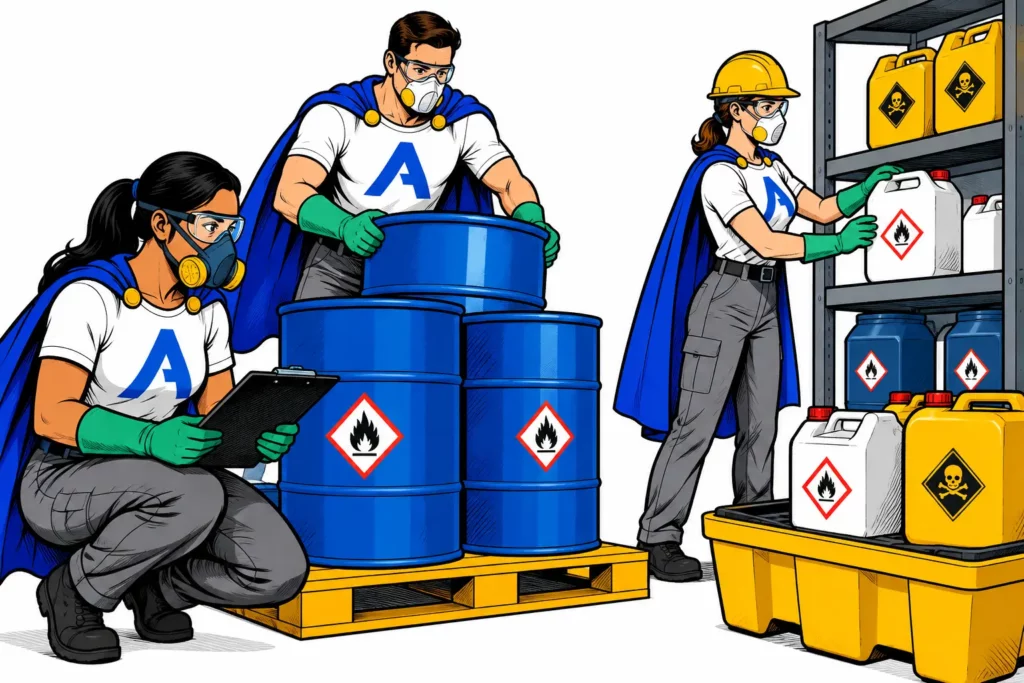
A leaking drum, an unlabelled spray bottle or cleaning chemicals stored beside an ignition source can turn a routine shift into an incident. This hazardous chemical storage guide explains the practical controls employers need when operating in Germany, from identifying substances to training the people who use them.
Chemical storage is not just a facilities issue. It connects directly to fire prevention, employee health, emergency response and your wider workplace risk assessment. The right arrangement depends on the substances, their quantities, the building and the work being carried out. A small office cleaning cupboard needs different controls from a warehouse holding solvents, aerosols or maintenance chemicals.
Start with the hazardous substances inventory
You cannot store hazardous substances safely if you do not know what is on site. Begin by creating and maintaining a hazardous substances register. Include substances brought in for cleaning, maintenance, production, pest control, laboratory work and vehicle or warehouse operations. Do not overlook decanted products in smaller containers.
For each substance, keep the current safety data sheet from the supplier. It tells you about hazards, exposure controls, first aid, firefighting measures, transport and disposal. The product label and safety data sheet should match what is physically present. If a container has no clear label, treat it as a problem to resolve immediately, not an item to leave for the next stocktake.
Under the Hazardous Substances Ordinance (GefStoffV), employers must identify hazards and take suitable protective measures. The risk assessment (Gefährdungsbeurteilung) is where you turn that duty into a site-specific plan. It should consider storage as well as use, including deliveries, internal movement, spills, waste and maintenance work.
Assess the real conditions, not the catalogue description
A safety data sheet is essential, but it is not your completed assessment. Consider where products are kept, who can access them, whether containers can fall or be damaged, and how employees would react if one leaked. Ventilation, temperature, drains, nearby ignition sources and the possibility of mixing incompatible substances all matter.
Technical Rule for Hazardous Substances TRGS 510 provides practical expectations for storing hazardous substances in portable containers. The measures you choose should be proportionate. A few correctly labelled cleaning products may be managed in a lockable, ventilated cupboard. Larger quantities or products with significant fire, toxic or environmental hazards may require a dedicated chemical cabinet, storage room or external storage solution.
Separate incompatible chemicals before they react
The most common storage failure is treating every chemical as if it belongs on the same shelf. It does not. Products that are harmless when used separately can release heat, fire, toxic gases or corrosive splashes if they leak together.
Separate chemicals according to their hazard information and compatibility. In practical terms, keep acids away from alkalis, oxidising agents away from flammable materials, and chemicals that react with water away from moisture sources. Flammables need protection from ignition sources, direct heat and unsuitable electrical equipment. Do not rely on a tidy shelf alone: use physical separation, separate cabinets or suitable containment where a spill could bring products together.
Secondary containment is often a sensible control for liquid products. Spill trays, bunds or compatible containment systems can prevent leaks reaching drains or mixing with another substance. However, the tray itself must be chemically compatible and large enough for the foreseeable spill scenario.
Storage height deserves attention too. Heavy containers should not be placed above shoulder height, and damaged racking can create an avoidable release hazard. Where hazardous substances are stored on warehouse racking, include the load, access and impact risks in your inspections and operating rules.
Design the storage area for normal work and emergencies
A compliant-looking cabinet is only part of the answer. Employees must be able to receive, retrieve and return products without bypassing the controls. Keep access routes clear, make labels visible and prevent unauthorised access, particularly where toxic, corrosive or highly flammable products are involved.
The storage area should have suitable ventilation where vapours, aerosols or gases could accumulate. It should be protected from weather, excessive heat and incompatible activities. Food, drink and personal items do not belong in chemical storage areas. Nor should chemicals be stored in reused food or drinks containers, even temporarily.
Emergency measures must reflect the actual risks. Depending on the substances, this may include spill materials, eye-wash provision, firefighting equipment, emergency contact arrangements and clear instructions for evacuation. Employees should know when they can deal with a small spill safely and when they must stop work, isolate the area and call for help.
Fire safety must be planned alongside chemical storage. Flammable products can change the risk profile of an otherwise ordinary workshop or stockroom. Your fire risk assessment should take account of quantities, storage locations, ignition sources and escape routes. Never place chemical storage where it could compromise an exit.
Keep labels, records and instructions usable
Documentation is valuable only if it helps people act correctly. Your hazardous substances register, safety data sheets, risk assessment, storage plan and operating instructions should be current and accessible to the people who need them.
Written operating instructions should use clear language and, where necessary, pictograms. International teams may need English-language training and instructions alongside other languages used at the site. The goal is understanding, not merely a signed attendance sheet.
Employees need instruction before they work with hazardous substances and at suitable intervals thereafter. Cover the specific hazards, required protective equipment, storage rules, hygiene measures, emergency actions and the process for reporting damaged or unidentified containers. Training should also address contractors. A contractor who stores paint, adhesives or cleaning agents in your building can create risks that your team still needs to manage.
Assign ownership, then check that controls work
Employers retain responsibility even when tasks are delegated. In many organisations, facilities, operations or warehouse managers oversee day-to-day storage, while an occupational safety specialist (Fachkraft für Arbeitssicherheit, or SiFa) supports the risk assessment and preventive measures. A company doctor (Betriebsarzt) can advise where chemical exposure may affect employee health.
A hazardous substances officer (Gefahrstoffbeauftragter) can provide useful coordination, especially at sites with varied chemicals or frequent deliveries. This role is not automatically a legal requirement for every business. What matters is that responsibilities are clear, the appointed person is competent, and the arrangements match your actual risks.
Check the storage area routinely. Look for expired or damaged products, missing labels, overfilled cabinets, blocked ventilation, absent spill materials and substances that no longer have a business purpose. Remove obsolete stock through an appropriate disposal route rather than allowing it to accumulate in a forgotten cupboard.
If an accident insurance institution (Berufsgenossenschaft, or BG) identifies deficiencies, respond with evidence of what you found, what you corrected and how you will prevent recurrence. A rushed tidy-up before an inspection is rarely enough. Inspectors will usually look for a consistent system: assessment, controls, employee instruction and documented review.
A practical three-step route to safer storage
First, inspect every storage point and build the inventory. This includes cupboards, workshops, cleaning stations, maintenance rooms, delivery areas and warehouse locations.
Second, assess hazards and correct the priority gaps. Typical actions include separating incompatible materials, improving labels, installing suitable cabinets or spill containment, removing redundant stock and updating emergency arrangements.
Third, document the arrangements and embed them in everyday work. Train employees, assign checks, review changes and revisit the assessment whenever you introduce a new chemical, change quantities, move premises or alter the work process.
Captain Safety can support this work from an on-site review through risk assessment, corrective actions, employee instruction and ongoing occupational safety support. If you are opening a German site, responding to a BG notice or unsure whether your current storage is adequate, requesting a quote is a sensible first step.
Questions employers often ask
Do all cleaning products need to be included?
Include products that are classified as hazardous and assess the actual products used on site. Many cleaning agents, descalers, disinfectants and aerosols carry hazard labels. The fact that a product is bought from a supermarket does not remove the need to manage it safely at work.
Can hazardous chemicals be stored in a general warehouse?
Sometimes, yes, but only if the warehouse area provides suitable conditions and separation from incompatible goods, ignition sources, people and escape routes. Storage requirements become more demanding as quantities and hazards increase. Assess the precise products and storage setup rather than relying on a general rule.
How often should the risk assessment be reviewed?
Review it when something changes and at planned intervals. Changes include new substances, increased quantities, altered storage locations, incidents, building work, changed staffing or new information in a safety data sheet. Regular checks help you spot gradual failures, such as unlabeled decanted containers or overcrowded cabinets, before they become an emergency.
Safe chemical storage is built in the quiet moments: a correct label, a clear shelf, a trained employee and a prompt decision to remove what no longer belongs on site.