
A letter from your accident insurance institution, a new warehouse opening or a workplace accident can turn health and safety from a background task into an urgent management issue. The external versus in-house HSE decision then becomes practically very quickly: do you build internal capability, appoint outside specialists, or combine both?
For employers operating in Germany, the answer is rarely about preference alone. It depends on your activities, risk profile, number of sites, growth plans and the work already sitting with your operations and HR teams. Above all, it must support your legal duties as an employer under the Occupational Health and Safety Act (Arbeitsschutzgesetz, ArbSchG).
Why the decision matters in Germany
German workplace safety duties are structured, documented and supported by defined specialist roles. Employers must assess workplace risks, take suitable preventive measures, arrange occupational health support and ensure employees receive appropriate instruction. The employer retains responsibility, even where work is delegated to a manager or delivered by an external provider.
This is where international companies can be caught out. A sensible global safety policy is useful, but it does not automatically meet German requirements. The practical expectations of an accident insurance institution (Berufsgenossenschaft, or BG), as well as rules such as DGUV V2 and DGUV V3, need to be reflected in how your workplace is inspected, documented and managed.
An external arrangement can give you access to that local knowledge immediately. An in-house arrangement can create closer day-to-day ownership. Neither is automatically better. The right model is the one that gives your people clear support while making sure hazards, actions and evidence do not fall through a gap.
When in-house HSE makes sense
An in-house HSE function is often a strong option for large, stable or high-risk operations. A manufacturing site with complex machinery, a large logistics operation with shifting vehicle movements, or a business with frequent process changes may benefit from having safety expertise present every day.
The greatest advantage is proximity. An internal HSE lead knows the people, routines, equipment and pressure points. They can spot changes early, challenge unsafe shortcuts and follow corrective actions until they are complete. Employees may also find it easier to raise issues with someone they see regularly.
However, appointing an internal employee does not by itself create a compliant safety function. The person needs suitable qualifications, enough protected time and a defined scope. An occupational safety specialist (Fachkraft für Arbeitssicherheit, or SiFa) has a distinct role and must be appointed appropriately. Depending on the workplace, you may also need support from a company doctor (Betriebsarzt), fire protection expertise and competent persons for statutory inspections.
The hidden challenge is capacity. A capable facilities manager or operations lead may understand the site very well, but their core job can make it difficult to maintain risk assessments, organise training, track inspection dates, review hazardous substances and respond properly to a BG request. If safety is continually postponed until next month, the function exists on paper rather than in practice.
Where external HSE brings an advantage
External HSE support is usually most valuable when you need specialist coverage without creating a full internal department. This can suit a foreign start-up establishing its first German entity, a retailer opening several locations, or a growing business whose internal contact needs experienced support rather than another full-time responsibility.
A good external partner begins with the actual workplace. That means inspecting offices, shops, warehouses or operational sites, identifying hazards and building legally structured risk assessments (Gefährdungsbeurteilungen). The work should then continue into corrective actions, employee instruction, appointments, records and annual review.
External support also brings breadth. One coordinated provider can arrange the occupational safety specialist, company doctor, fire safety work, hazardous substances management (Gefahrstoffmanagement), equipment inspections and safety committee support. This matters where several duties overlap. For example, a warehouse may need racking inspections under DGUV 208-043, electrical equipment checks under DGUV V3, clear fire protection arrangements and practical training for employees using equipment.
There is a responsiveness benefit too. If you have received a deficiency notice, need to report and investigate an accident, or face an upcoming inspection, an experienced external team can help establish what evidence exists, what actions are needed and who needs to do what. That is not a promise that an authority will accept every outcome. It is a way to replace uncertainty with a structured plan.
The trade-off is that an external specialist is not on site every day. They rely on accurate information, access to employees and a reliable internal contact. If site managers do not implement agreed actions, even the best external reports will not make the workplace safer.
External versus in-house HSE: the questions to ask
Start with the work, not the job title. A low-risk office with one location has different needs from a distribution centre with racking, loading areas, temporary workers and changing shifts. Headcount matters for some organisational duties, but risk and operational complexity matter just as much.
Ask whether your internal team has the competence and time to manage the following work consistently:
- keeping risk assessments current when workplaces, tasks or equipment change
- arranging mandatory specialist appointments and occupational medicine
- documenting employee instruction and following up unsafe practices
- managing hazardous substances, fire protection and statutory inspections
- responding to accidents, deficiency notices and requests from the BG
If the answer is partly yes, a hybrid model may be the best fit. Your internal contact can own local communication and action tracking, while external specialists provide the formal appointments, technical expertise and independent review. This model works particularly well for businesses that want a strong internal safety culture without carrying every specialist capability in-house.
If the answer is no, outsourcing can provide a more dependable starting point. It gives you a defined route from initial inspection to action plan and ongoing support, rather than asking a busy manager to interpret unfamiliar requirements alone.
Do not confuse outsourcing with transferring responsibility
This point deserves clarity. You can appoint an external occupational safety specialist and company doctor. You can ask a provider to conduct inspections, prepare documentation and deliver training. But as employer, you remain accountable for ensuring suitable measures are in place and actually implemented.
That means leadership still needs visibility. You should know the principal risks at each site, the status of important corrective actions, which inspections are due and whether employees have received relevant instruction. Managers should understand who to contact when something changes, such as a new chemical, a revised layout, a new piece of work equipment or an accident.
A safety committee (Arbeitsschutzausschuss) can help larger organisations bring these parties together. Where required, it creates a regular forum for the employer, safety specialists, company doctors, employee representation and other relevant roles to discuss trends, incidents and improvements. It should not become a meeting that simply records problems without assigning action.
A practical route to the right model
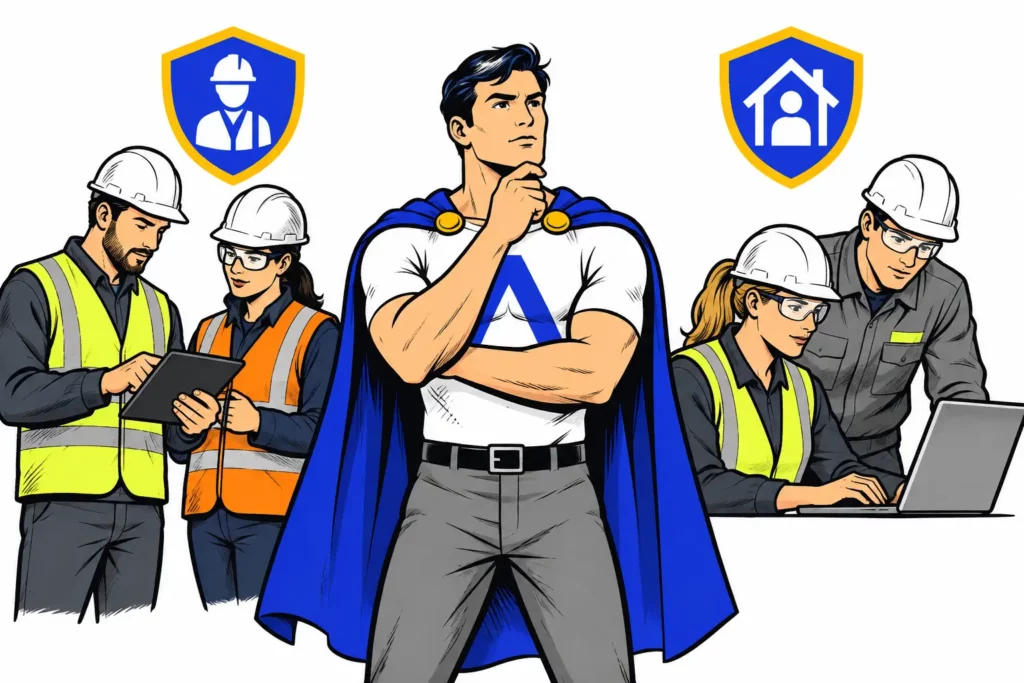
The strongest decision is usually based on a short fact-finding exercise rather than assumptions. Captain Safety approaches this as a three-step journey.
1. Inspect the real workplace
Review your sites, work activities, employee numbers, equipment, substances, existing documents and recent incidents. Check whether required appointments and inspection records are in place. This establishes the gap between what you have and what your operation needs.
2. Build the compliance plan
Set priorities according to risk and urgency. This may include updating risk assessments, appointing specialists, arranging employee training, addressing fire protection measures or correcting inspection findings. Assign each action to an owner and give it a realistic deadline.
3. Keep the system active
Safety management needs review as the business changes. New premises, new equipment, new processes and increased headcount can all affect your duties. Regular external review, supported by a committed internal contact, keeps action from becoming a one-off project.
Choose support that fits the work
Building in-house HSE capability can be the right long-term investment when your scale and risk justify a dedicated team. External HSE can be the practical choice when you need qualified support across Germany, clear documentation and rapid help without building that whole function internally. For many employers, the most effective answer is a hybrid: internal ownership, backed by external expertise.
The key is not to wait for a letter, accident or inspection to reveal the gaps. Give workplace safety a named owner, a clear plan and the specialist support your people need. That is how a compliance burden becomes a safer, calmer operation for everyone involved.