
A letter from an accident insurance institution, a new warehouse opening or a workplace accident often brings the same question into focus: company doctor versus safety specialist, which one do you actually need? For most employers operating in Germany, this is not an either-or decision. These are two distinct preventive roles with different expertise, and both may be required as part of your occupational health and safety arrangements.
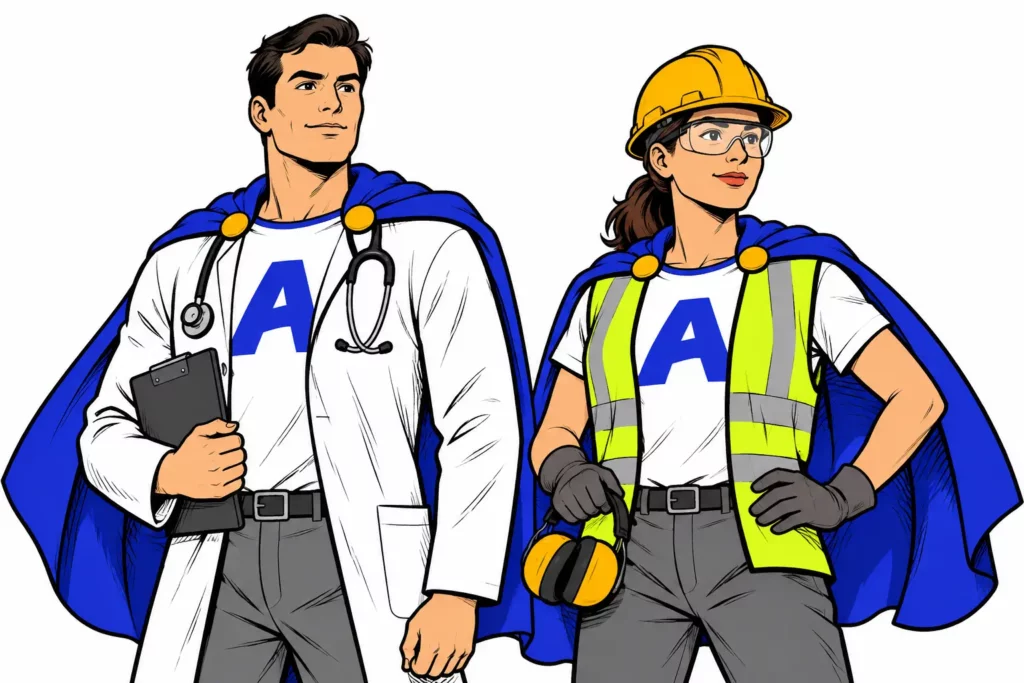
The employer remains responsible for safe work. Appointing competent external support does not transfer that responsibility, but it gives you the qualified advice, inspections and documentation needed to make sound decisions. Think of the company doctor and safety specialist as two members of your health and safety superhero team: one focuses on how work affects people, while the other focuses on how the workplace, equipment and processes can be made safer.
Company Doctor Versus Safety Specialist: The Core Difference
A company doctor (Betriebsarzt) is a physician with specialist occupational medicine expertise. Their role is to protect employee health in relation to the actual work being carried out. They assess health risks from exposure, advise on preventive medical care and help employers design work that takes account of employees’ physical and psychological health.
An occupational safety specialist (Fachkraft für Arbeitssicherheit, or SiFa) is the technical and organisational safety adviser. The safety specialist examines hazards arising from workplaces, work equipment, buildings, procedures and working methods. They help you identify practical controls, from guarding a machine to improving traffic routes for pedestrians and forklift lorries.
Their perspectives overlap, but they are not interchangeable. A warehouse worker with repetitive strain, for example, may need occupational medical advice about fitness for the task and preventive health measures. The same worker’s manual-handling risk also requires the safety specialist to assess load weights, storage heights, equipment, training and the design of the work area.
Both roles are rooted in German occupational safety law. The Occupational Health and Safety Act (Arbeitsschutzgesetz, ArbSchG) requires employers to assess work-related hazards and put suitable protective measures in place. The Act on Occupational Physicians, Safety Engineers and Other Occupational Safety Specialists (ASiG), together with DGUV Regulation 2, sets the framework for appointing and involving these advisers.
What the Company Doctor Does
The company doctor provides occupational medical advice that is relevant to your specific workforce and activities. This can include work involving hazardous substances, noise, respiratory protection, night work, screen-based work, heavy physical tasks or biological agents. The exact need depends on the risk assessment (Gefährdungsbeurteilung), not simply on your sector label.
A central task is advising on occupational preventive medical care under ArbMedVV. In some circumstances, preventive appointments must be offered or arranged because of a defined exposure. In others, employees can request occupational medical advice where their work may affect their health. The doctor can also advise on suitable workplace adjustments, vaccinations where relevant to the work, and return-to-work considerations.
Medical confidentiality matters. The employer receives the information needed to manage workplace risk and fulfil duties, but not an employee’s diagnosis or confidential medical details. That separation protects employees and enables the doctor to give independent professional advice.
The company doctor is not your general practitioner service, nor are they there to decide whether an employee is a good or bad performer. Their purpose is prevention: spotting where work could harm health and helping you act before harm occurs.
What the Safety Specialist Does
The safety specialist turns legal duties and site conditions into practical safety management. They inspect workplaces, review existing records and support the risk assessment process. In an office, that might involve workstation set-up, emergency arrangements and psychosocial hazards. In retail, logistics or production, it may also cover goods storage, racking, vehicle movements, lifting operations, machinery, hazardous substances and fire risks.
They help you define controls, assign responsibilities and verify whether measures are working. This commonly includes employee instruction, accident investigation support, safety committee meetings, inspections of work equipment and follow-up on deficiencies identified by an authority or the accident insurance institution (Berufsgenossenschaft, or BG).
The safety specialist should be involved early, not only after an incident. Bringing them in when you open a new location, introduce a chemical, alter a process or purchase equipment is usually more effective than correcting avoidable problems later.
Where Their Work Meets
The strongest occupational health and safety arrangements do not place these roles in separate boxes. The company doctor brings medical insight; the safety specialist brings technical and organisational insight. Together, they give you a fuller view of risk.
Consider a cleaning team using chemical products. The safety specialist checks labelling, storage, safety data sheets, ventilation, dilution procedures, personal protective equipment and training. The company doctor advises on potential health effects, skin protection, respiratory exposures and whether occupational preventive medical care is relevant. Your risk assessment should bring those findings together into clear controls that supervisors and employees can follow.
The same joined-up approach applies to psychological strain. The safety specialist can help structure an assessment of work organisation, workload, shift patterns, role clarity and conflict risks. The company doctor can advise on the health implications and suitable preventive measures. Neither role replaces competent HR management, but both can help you recognise work-related factors that need attention.
Do You Need Both Roles?
For many employers, yes. The scope and frequency of support depend on your workforce size, sector, hazards and the rules of the relevant BG under DGUV Regulation 2. A small, low-risk office will not require the same level of support as a warehouse with shift work, material handling and lorry movements. But low apparent risk does not mean no duty.
There are alternative support models for certain smaller businesses, and the details can depend on the applicable accident insurance institution. That is why copying another company’s arrangement is risky. A solution suitable for a software office may be unsuitable for a retailer with stockrooms, or a scale-up operating laboratory equipment.
Your legal obligation is not met by placing a name on an appointment letter. Advisers need enough time, access and information to understand the work. They must be able to raise concerns directly with management, and you need to consider their recommendations. If an inspection follows, authorities will look beyond whether appointments exist and ask whether your safety arrangements are active and documented.
A Practical Three-Step Route to Compliance
If you are unsure what is missing, start with the actual site rather than a generic checklist.
1. Inspect the work and identify gaps
Review the workplace, roles, equipment, substances, training records, emergency arrangements and previous incidents. Confirm which medical and safety expertise is needed, and whether current appointments and documents reflect reality.
2. Build risk assessments into workable actions
Set out hazards, controls, responsible people and review dates. Address urgent issues first, such as unsafe racking, missing equipment inspections, inadequate fire precautions or untrained staff. The aim is a system people can use, not a document that stays in a folder.
3. Keep both advisers involved
Schedule the required support, provide reports to the right internal contacts and revisit assessments when work changes. Regular review is especially valuable after an accident, a BG notice, rapid growth or a new site launch.
Captain Safety can coordinate company doctor and safety specialist support alongside risk assessments, training, inspections and corrective action across Germany. Request a quote when you need a clear view of your duties or prompt help responding to a compliance trigger.
Common Questions About the Two Roles
Can a company doctor carry out the safety specialist’s role?
Not simply because they are a doctor. The roles require different qualifications and professional expertise. A company doctor may identify a health issue connected to work, while the safety specialist develops or reviews the technical and organisational controls. One person may hold more than one relevant qualification in exceptional cases, but the duties must still be competently fulfilled as separate functions.
Does the safety specialist provide medical examinations?
No. Medical examinations, occupational medical consultations and advice on medical suitability fall within the company doctor’s professional remit. A safety specialist can identify when health exposures may exist and ensure the risk assessment addresses them, but they do not replace occupational medical care.
What should you do after a BG deficiency notice?
Treat the notice as a structured action plan, not as an administrative nuisance. Clarify the deadline, inspect the affected area, gather your existing evidence and appoint suitable support where roles or documentation are missing. Corrective measures should address the underlying hazard, not only the wording of the notice.
A safe workplace is built when medical insight and practical prevention meet. Give both roles a place in your operations, and your people will have more than paperwork behind them when work gets demanding.