
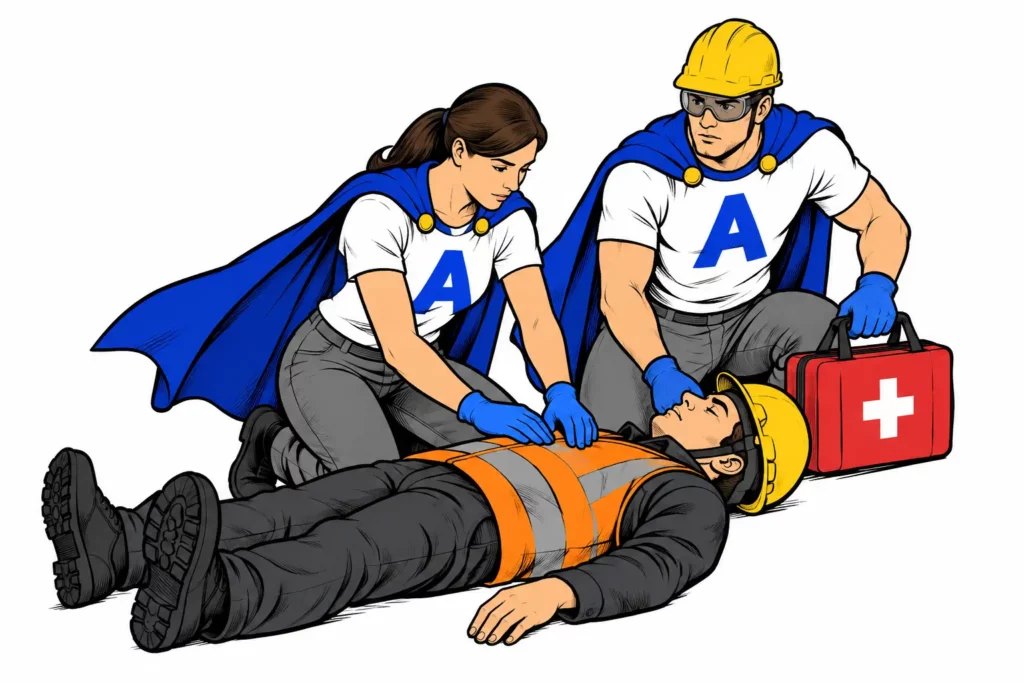
A warehouse employee steps backwards from a packing station, catches a foot on damaged floor edging and falls. They are conscious, but in pain. The shift manager has a first-aid box, a busy loading area and an urgent question: what must happen next?
This accident response case study shows how a German employer can move from the first minutes after an incident to meaningful corrective action. It is an illustrative scenario, not a real client case. Its purpose is to make the practical sequence clear, especially for employers who are new to German workplace safety duties.
The scenario: a preventable warehouse fall
The business operates a growing fulfilment warehouse in Germany. It has employees on rotating shifts, temporary workers during peak periods and regular lorry movements at the loading bays. Its basic safety arrangements exist, but they have not kept pace with operational growth.
On an afternoon shift, an employee trips on loose edging beside a work area and falls heavily. A trained first aider (Ersthelfer) provides initial support, while the manager stops work around the area and arranges medical assessment. The employee is later unable to work for more than three calendar days.
At first glance, the cause appears simple: damaged edging. A proper response shows a wider picture. Why was the defect not identified earlier? Was there a routine inspection? Did the shift team know how to report defects? Had the work area changed without the risk assessment being reviewed? Were similar hazards present elsewhere?
That distinction matters. Treating the injury is urgent. Preventing the next injury is the employer’s continuing duty.
Immediate response comes before paperwork
The first priority is the injured person. Provide first aid, call emergency services where needed and ensure the injured employee receives appropriate medical treatment. Depending on the injury and treatment required, an occupational accident physician (Durchgangsarzt, or D-Arzt) may be involved through the statutory accident insurance process.
The site must then be made safe. In this example, the manager marks off the packing station, removes the immediate trip risk where this can be done safely and redirects work. Continuing operations around a known hazard simply creates a second opportunity for harm.
Early facts should be recorded while memories are clear. This includes the time and location, work being performed, equipment or workplace conditions involved, witnesses, first-aid measures and any photographs of the scene. The goal is accuracy, not blame. Do not ask an injured person to produce a detailed account before they are well enough to do so.
A first-aid record is also required. It documents that assistance was given and can provide useful evidence if questions arise later. It must be handled confidentially, because health information requires appropriate protection.
Reporting duties in this accident response case study
German employers have reporting duties when a workplace accident leaves an employee unable to work for more than three calendar days. The employer must submit an accident report to the relevant accident insurance institution (Berufsgenossenschaft, or BG) within three days of learning about the accident. In fatal cases, the BG must be informed immediately.
The exact process and forms can vary by institution and sector, but the core task is consistent: report factually, promptly and completely. The report should not speculate about fault or promise corrective measures that have not yet been agreed.
The works council, where one exists, should receive a copy of the report. Internal stakeholders may also need a clear update, including HR, site management and the occupational safety specialist (Fachkraft für Arbeitssicherheit, or SiFa). If the employee is absent, practical return-to-work arrangements should be considered once medically appropriate.
In the warehouse scenario, the manager initially assumed that the accident report was the end of the process. It was only the start. A report explains what happened. It does not demonstrate that the employer has addressed the underlying risk.
Investigate the system, not only the fall
Under the Occupational Health and Safety Act (Arbeitsschutzgesetz, ArbSchG), employers must identify hazards, assess risks and put suitable protective measures in place. The relevant risk assessment (Gefährdungsbeurteilung) is therefore the central document to revisit after an accident.
The safety specialist examines the area with the operations manager. They find that temporary cable covers and floor edging had been installed during a layout change. The original installation was suitable, but later movement of trolleys had loosened the edging. No one owned the weekly visual check, and employees had reported similar minor defects informally rather than through a documented process.
This is a common pattern. The direct cause may be a loose edge, a wet floor, a reversing vehicle or a faulty ladder. The contributing causes often sit in the system around it: unclear responsibilities, weak maintenance controls, rushed changes to a workspace or training that does not reflect real work.
A useful investigation asks three practical questions. What allowed this accident to happen? What controls should have prevented it? What evidence will show that the improved controls are being followed?
The answers should be proportionate. A minor injury in a low-risk office requires a different depth of review from a serious incident involving warehouse traffic, machinery or hazardous substances. Yet every incident deserves a documented assessment of whether existing controls remain suitable.
Corrective action should have an owner and a deadline
For this site, the corrective plan included replacing the damaged edging, inspecting comparable work areas and updating the warehouse housekeeping standard. The employer also introduced a documented weekly inspection of floors, walkways and temporary workplace alterations.
Training was refreshed for shift leaders and employees. The focus was not merely “watch where you walk”. Staff were shown how to isolate a defect, whom to tell, how to record it and why a small defect can become a serious incident during a busy shift.
Each action needs a named owner, due date and verification step. “Facilities will look into it” is not a corrective measure. “Facilities manager replaces all damaged edging by Friday, with a recorded follow-up inspection by the safety specialist” is one.
The three-step route from incident to control
A capable external safety partner can bring structure when your internal team is under pressure. The work normally follows three clear stages.
1. Stabilise and document
Support the immediate response, preserve relevant facts, assess reporting duties and organise the records required after the accident. This stage reduces confusion when managers are dealing with an injured colleague and operational disruption at the same time.
2. Inspect and assess
Inspect the location, review the risk assessment and identify direct, contributing and organisational causes. This may include work equipment, traffic routes, training records, maintenance arrangements, fire safety interfaces or hazardous substances controls, depending on the incident.
3. Correct and verify
Create a practical action plan, assign responsibilities, update documents and deliver targeted employee instruction. Follow-up is essential. A control that exists only in a spreadsheet does not protect the next shift.
For employers with wider compliance gaps, an incident can also reveal missing statutory support. Under DGUV V2, companies may need defined support from an occupational safety specialist and a company doctor (Betriebsarzt). The required scope depends on factors including workforce size, sector and risk profile. The accident itself does not automatically prove non-compliance, but it can expose where arrangements need strengthening.
What this case study changes for employers
The strongest outcome is not a polished incident file. It is a workplace where employees know how to respond, supervisors know when to escalate and hazards are found before someone gets hurt.
If you have received a deficiency notice, need to report an accident or suspect that your risk assessments no longer reflect the way work is actually done, act promptly. Captain Safety can help you inspect the facts, organise the corrective work and build an ongoing safety routine that fits your operation.
A workplace accident is disruptive. Your response can turn that disruption into a clearer, safer standard for every person who walks onto the site.