
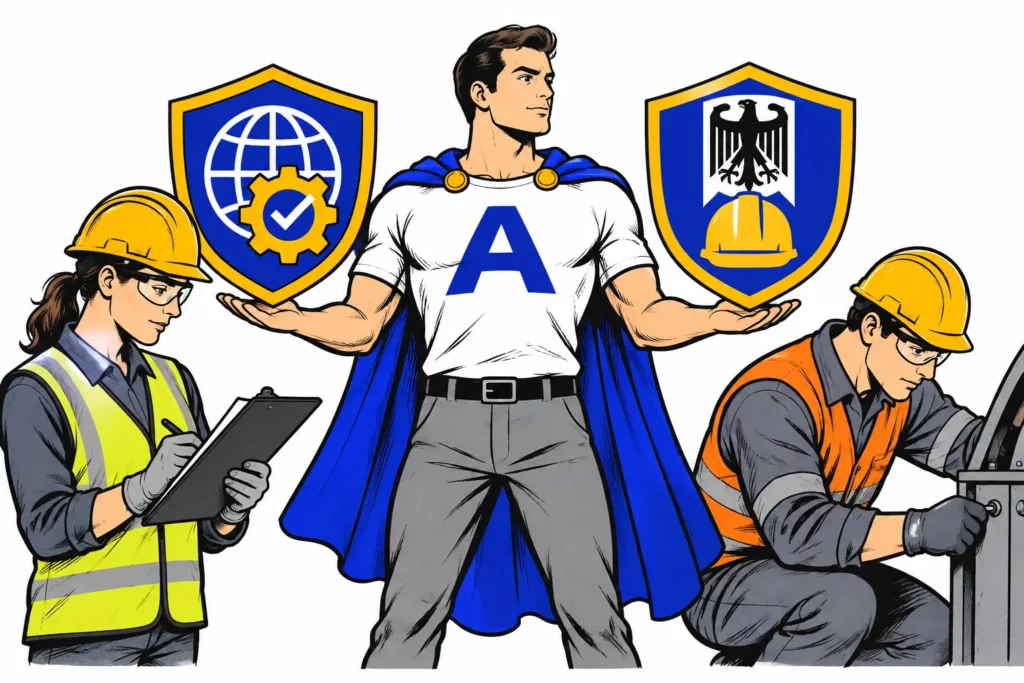
A new German site, a warehouse opening or a letter from the accident insurance institution can quickly raise the same question: ISO 45001 versus DGUV, which one does your business actually need? The short answer is that they do different jobs. DGUV requirements form part of the statutory health and safety framework that applies to employers in Germany. ISO 45001 is an international management-system standard that can help you organise and demonstrate your approach, but it does not replace German legal duties.
For an employer, treating them as alternatives is the risky part. Your first task is to meet the duties that apply to your workplace. Certification can then be a useful strategic choice, particularly where customers, tenders or a growing international operation expect a recognised occupational health and safety management system.
ISO 45001 versus DGUV: different purposes
German Social Accident Insurance (Deutsche Gesetzliche Unfallversicherung, DGUV) is the umbrella organisation for the statutory accident insurance system. Your business belongs to an accident insurance institution (Berufsgenossenschaft, or BG) based on its sector. These institutions issue accident prevention rules, provide guidance and may inspect workplaces or follow up after an accident.
The legal foundation is wider than DGUV alone. The Occupational Health and Safety Act (Arbeitsschutzgesetz, ArbSchG) requires employers to assess workplace risks, put suitable protective measures in place, inform and train employees, and review whether those measures work. Other rules address specific subjects such as work equipment, hazardous substances and occupational medical precautions.
ISO 45001 takes a management-system view. It asks an organisation to establish a policy, identify risks and opportunities, involve workers, set objectives, control operations, audit its own system and improve over time. An accredited certification body can assess whether that system conforms to the standard.
The distinction matters. DGUV and statutory rules ask, in practical terms, whether you have met duties at the German workplace. ISO 45001 asks whether your organisation has a coherent system for managing occupational health and safety. A good ISO system should support compliance, but a certificate is not proof that every German legal obligation has been met.
What DGUV compliance means in practice
For many international employers, DGUV first becomes visible through a request for documentation, an inspection or a deficiency notice. By that point, the issue is rarely a single missing form. Authorities usually want to see that responsibilities, assessments, training and corrective actions work in everyday operations.
Appointed experts and occupational health support
Under DGUV V2 and the Act on Occupational Safety Specialists and Company Doctors (Arbeitssicherheitsgesetz, ASiG), employers generally need access to an occupational safety specialist (Fachkraft für Arbeitssicherheit, or SiFa) and a company doctor (Betriebsarzt). The required support depends on factors including headcount, sector and risk profile.
These roles are not ceremonial appointments. The safety specialist advises on risk assessments, workplace design, accident prevention and safety measures. The company doctor advises on occupational health, medical precautions and work-related health risks. In a logistics operation, for example, that may include manual handling, forklift activity, shift work, noise and fitness for specific tasks.
Employers remain responsible even when these functions are outsourced. External support can provide the specialist competence, but management must ensure recommendations are considered, measures are funded and actions are implemented.
Risk assessments must reflect the real work
A risk assessment (Gefährdungsbeurteilung) is a central legal requirement, not a document to create once and file away. It should cover the actual people, activities, equipment and conditions at each location. An office assessment may focus on display screen work, emergency arrangements, psychosocial strain and electrical equipment. A warehouse assessment needs to go further into vehicle routes, racking, loading bays, lifting, slips, storage and fire risk.
The assessment should lead to proportionate controls, named responsibilities and evidence that employees understand the safe method of work. It must also be reviewed when work changes, after accidents or near misses, and when new hazards emerge.
Inspections, training and documentation
DGUV V3 requires recurring inspections of electrical equipment and installations. DGUV 208-043 sets expectations for the inspection of racking and storage systems. Fire protection duties, hazardous substances controls and work equipment obligations can create further inspection, instruction and documentation requirements.
Frequency and scope depend on the equipment and workplace conditions. Copying a schedule from another country, or assuming a supplier certificate covers your ongoing duty, can leave gaps. The useful question is not simply, “Do we have a document?” It is, “Can we show that the workplace is safe, that checks happen when due, and that identified defects are corrected?”
What ISO 45001 adds to a German safety programme
ISO 45001 is especially valuable when health and safety needs to work consistently across several sites or countries. It gives senior leaders a common structure for setting responsibilities, tracking objectives, consulting employees, reviewing performance and addressing recurring issues.
For a scale-up, this can prevent safety activity becoming reactive as headcount grows. For an established corporation, it can create clearer governance between a central HSE team and local German operations. It may also be requested in procurement processes where clients want evidence of a mature management approach.
There is a trade-off. Certification takes management time and ongoing discipline. You need internal audits, management reviews, controlled documentation and a willingness to address findings rather than simply prepare for an external audit. A small, low-risk German office may need solid statutory compliance long before certification delivers meaningful commercial value.
The practical difference at a glance
| Question | DGUV and German duties | ISO 45001 | | — | — | — | | Is it compulsory? | Many requirements are statutory and apply to employers in Germany. | Usually voluntary, unless required by a customer, group policy or contract. | | What is the focus? | Safe workplaces and fulfilment of specific legal duties. | A structured occupational health and safety management system. | | Who checks it? | Accident insurance institutions and other relevant authorities may inspect. | An independent certification body audits against the standard. | | Does it replace the other? | No. | No. It should support, not substitute for, legal compliance. |
Which approach is right for your business?
Start with DGUV and legal compliance if you are opening, expanding or regularising a German operation. You need the right appointments, a site-specific risk assessment, employee instruction, applicable inspections and a reliable method for closing deficiencies. This is true whether or not you plan to pursue ISO certification.
Consider ISO 45001 when you have a clear business reason for it. That could be a tender requirement, a group-wide standard, frequent client audits, several operating locations or a leadership decision to formalise safety governance. It is most effective when built on accurate local compliance work, not when used as a top layer over missing basics.
If your company is already certified elsewhere, check the German detail carefully. A global policy may say that risk assessments are required, but it may not identify DGUV V3 inspection obligations, specify local occupational health support or reflect the expectations of your relevant accident insurance institution.
A three-step route from uncertainty to control
First, inspect the real operation. Review the premises, work activities, existing documents, appointments, equipment and recent incidents. This identifies both immediate risks and missing compliance foundations.
Second, prioritise and correct. Create or update risk assessments, arrange required specialist support and inspections, train employees, and assign owners and deadlines for every measure. Urgent deficiencies should be addressed first, especially where there is a credible risk of injury or enforcement action.
Third, maintain and improve. Schedule annual reviews, repeat inspections, safety committee meetings where required, and refresher training. If ISO 45001 is part of your plan, connect these local activities to internal audits, management reviews and continual improvement rather than duplicating paperwork.
Captain Safety can support this journey nationwide, from an initial site inspection and corrective action plan through to ongoing occupational safety, occupational medicine and ISO 45001 certification support. If you have received a letter, are preparing for an inspection or need clarity before a new site opens, requesting a quote early gives you more room to act methodically.
When an accident insurance institution contacts you
Do not ignore a letter or treat it as a purely administrative exercise. Read the requested actions and deadline carefully, gather the relevant evidence, and investigate whether the issue points to a wider gap. A missing safety specialist appointment, for instance, may also mean that risk assessments, training records and safety consultations need attention.
A prompt, factual response is usually better than rushing out generic documents. Inspect the workplace, document the corrective action and keep records of what has changed. Where requirements are unclear or the deficiency is significant, get competent support that understands both the operational setting and the German framework.
The strongest position is not choosing ISO 45001 or DGUV. It is building a workplace where legal duties are visible in daily practice, employees know how to work safely, and improvement continues long after the first inspection has passed.