
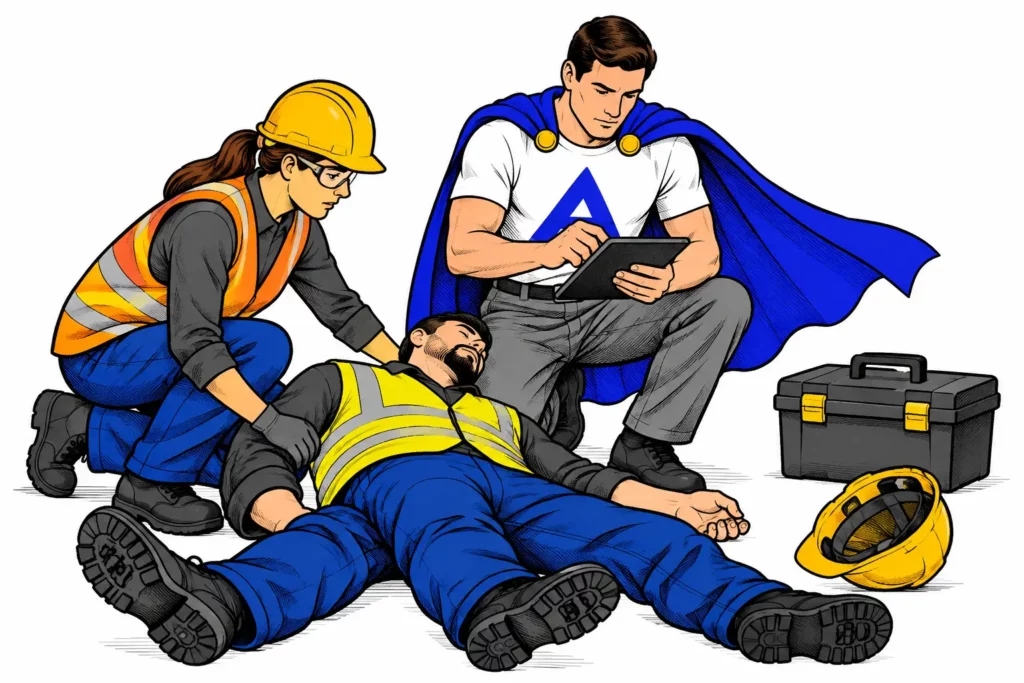
A delivery driver slips on a wet warehouse floor. A colleague cuts their hand while opening stock. An employee is injured on the way to work. In each case, your first duty is to get help and make the area safe. But you also need to know how to report workplace accidents correctly, particularly when the incident meets Germany’s formal reporting threshold.
For employers operating in Germany, accident reporting is not just an administrative task. A clear report protects the injured person’s access to statutory support, gives your accident insurance provider the facts it needs, and helps you address the cause before someone else is harmed. The best response is calm, factual and prompt.
Make People Safe Before You Start Paperwork
Arrange first aid immediately and call emergency services where needed. Keep the injured person safe, prevent further access to the hazard and preserve the scene where this can be done without creating further risk. For example, isolate damaged equipment, cordon off a spill or stop a loading activity.
Every workplace should have trained first aiders, suitable first-aid equipment and a first-aid record (Verbandbuch). Record the treatment as soon as possible, including the date, time, location, injured person, witnesses, what happened and the assistance provided. These records generally need to be retained for five years.
A first-aid entry is necessary even where the injury appears minor. Symptoms can worsen later, and a contemporaneous record can be valuable if the employee needs medical treatment or an insurance claim follows. Treat the record as confidential health information and restrict access accordingly.
When a Formal Accident Report Is Required
In Germany, you must submit an accident notification (Unfallanzeige) when an insured employee is killed or is unable to work for more than three calendar days because of a workplace accident. The day of the accident does not count towards those three days.
The notification must normally reach the relevant accident insurance institution (Berufsgenossenschaft, or BG) within three days of you becoming aware of the reportable accident. Depending on the organisation and sector, the responsible body may instead be a municipal accident insurance fund (Unfallkasse). Your insurer’s reporting form or online portal will set out its preferred submission route.
This threshold means not every first-aid case requires a formal accident notification. It does not mean you should ignore less serious events. All injuries, dangerous occurrences and near misses can reveal gaps in supervision, equipment, training or workplace layout.
For a fatal accident, inform the accident insurance provider and the competent occupational safety authority (Arbeitsschutzbehörde) immediately. Serious events may also require urgent contact with other authorities, depending on the circumstances. If there is uncertainty, act promptly, preserve the facts and seek competent support rather than waiting for every detail to be resolved.
How to Report Workplace Accidents Step by Step
1. Establish the facts without assigning blame
Speak to the injured employee if appropriate, as well as witnesses and the responsible supervisor. Record what happened before, during and immediately after the incident. Check the location, equipment, work instructions, training records and any relevant shift or maintenance information.
Keep the language factual. “Employee slipped while carrying two boxes through the dispatch area” is useful. “Employee was careless” is not an investigation finding. Avoid speculation about medical causes, liability or fault.
2. Complete and send the accident notification
Use the form required by your relevant BG or accident insurance fund. It will typically ask for the employer’s details, the injured person’s details, the time and place of the event, a concise description of what occurred, the nature of the injury and witnesses.
Submit the report within the deadline, keeping a copy with your safety records. If you have a works council, provide it with a copy. You must also provide a copy to the injured person if they request one. Inform your occupational safety specialist (Fachkraft für Arbeitssicherheit, or SiFa) and company doctor (Betriebsarzt) about the reportable incident so they can support the follow-up.
3. Correct the condition that allowed the accident
Reporting the event does not close the matter. Your next job is to identify what needs to change. This may be a straightforward correction, such as replacing damaged anti-slip flooring. It may also be broader, such as revising manual handling arrangements, separating pedestrians from forklift routes or improving induction training for temporary staff.
Update the relevant risk assessment (Gefährdungsbeurteilung). Under the Occupational Health and Safety Act (Arbeitsschutzgesetz, ArbSchG), employers must assess workplace risks and put suitable protective measures in place. An accident is a clear reason to test whether those measures were adequate in practice.
What Your Internal Record Should Cover
Alongside the formal notification, maintain an internal incident file. This makes your corrective work traceable and gives you a sound basis for discussions with your safety specialist, company doctor or accident insurance provider.
For a meaningful record, include:
- the date, time, exact location and activity being performed
- people involved, witnesses and immediate first-aid action
- photos, sketches or equipment information where relevant
- the immediate cause and contributing conditions
- actions taken, the responsible person and completion dates
- a review of whether the risk assessment, work instruction or training needs revision
Do not turn this into a paperwork exercise. A short, accurate record that leads to a completed corrective action is more useful than a long report that sits unread in a folder.
Do Not Overlook Commuting Accidents and Near Misses
An accident on the direct route between home and work may be covered as a commuting accident. Detours for private reasons can change the position, so record the circumstances carefully and contact the relevant accident insurance provider if the case may meet the reporting threshold.
Near misses are not normally submitted using the formal accident notification process, but they deserve attention. A pallet falling beside an employee, a failed racking beam or a forklift reversing into a pedestrian route can expose the same failures that later cause injury. Encourage staff to report these events without fear of blame.
A reporting culture works when employees see action follow their reports. Explain what changed: a route was marked, a guard was replaced, a process was stopped or a team received refresher training. That feedback builds trust and makes future reporting more likely.
Turn the Accident Into Preventive Action
For recurring or serious incidents, involve the right people early. Your safety specialist can assess technical and organisational causes. Your company doctor can advise on occupational health aspects and suitable return-to-work measures. Line managers should own day-to-day improvements, because they control how work is actually carried out.
Look beyond the final event. A fall may involve poor housekeeping, but also rushed picking targets, inadequate lighting, unsuitable footwear rules or unclear responsibility for cleaning. A hand injury may point to a missing guard, but also to a machine that was overdue for inspection or a worker who had not been trained on the task.
This is where an external review can be particularly useful. Captain Safety can help you investigate the incident, update the risk assessment, document corrective measures and put ongoing checks in place across your German sites.
A Three-Step Support Route After an Accident
If an accident has exposed wider safety gaps, take a structured route. First, inspect the workplace and establish what happened. Second, prioritise immediate corrective actions, documentation and any required reporting. Third, build prevention into routine operations through risk assessments, training, inspections and regular review.
That approach is proportionate. A minor isolated incident may need only a local correction and a documented review. A serious injury, repeated near misses or a deficiency notice from an accident insurance provider may justify a broader review of your safety management arrangements.
Frequently Asked Questions
Do I report every workplace injury to the BG?
No. Record every first-aid case internally, but a formal accident notification is generally required when the employee dies or cannot work for more than three calendar days. Report serious events promptly and check with the relevant insurer where the facts are unclear.
Who is responsible for submitting the report?
The employer is responsible for ensuring the report is made. You can ask an HR manager, operations lead or external safety adviser to prepare it, but legal responsibility does not disappear through delegation.
What happens after the report is sent?
The accident insurance provider may review the case, arrange benefits or request further information. Your own priority remains prevention: investigate the causes, complete corrective actions and update your workplace controls where needed.
A well-handled accident report is evidence that you take people seriously when something goes wrong. Make the record while facts are fresh, fix what you find and give your team confidence that safety concerns lead to real action.