
A letter from an accident insurance institution, an approaching site opening or a recent accident can make workplace inspections feel urgent very quickly. For employers in Germany, inspections are not simply a walk around the office, shop or warehouse. They are how you identify hazards, prove that controls are working and act before a minor defect becomes an injury, disruption or formal deficiency notice.
The key is to treat inspections as part of an active health and safety system, not a one-off event created for an authority visit. The Occupational Health and Safety Act (Arbeitsschutzgesetz, ArbSchG) requires employers to assess risks, put suitable protective measures in place and review whether those measures remain effective. Regular inspection gives you the evidence to do that.
What workplace inspections should achieve
A useful inspection answers three practical questions: what could harm people here, are the agreed controls in place, and what needs to happen next? The answer will differ between a serviced office, a retail unit and a logistics warehouse, but the principle stays the same.
In an office, the inspection may focus on emergency exits, display screen equipment, first aid arrangements, electrical equipment, fire safety and safe storage. In a warehouse, vehicle routes, racking, loading areas, pedestrian segregation, work equipment and manual handling may need much closer attention. Where hazardous substances are used, stored or produced, labelling, safety data sheets, ventilation, spill controls and employee instruction also need review.
An inspection is not the same as a risk assessment (Gefährdungsbeurteilung), although the two belong together. The risk assessment sets out hazards, people at risk and the controls required. Inspections check whether those controls are still suitable in the real workplace. A signed document will not protect anyone if an emergency route is blocked, a rack upright is damaged or staff have not been trained for changed work.
The inspections German employers commonly need
Some checks are part of general workplace safety management. Others are formal inspections of particular equipment or installations, with set intervals and qualified inspectors. Confusing these categories is a common reason companies leave important gaps.
Routine workplace safety checks
Routine checks are planned site inspections carried out at a frequency that reflects the risk. A busy warehouse may need frequent visual checks of traffic routes and racking, while a low-risk office may use periodic documented inspections alongside day-to-day reporting of defects.
The person inspecting should understand the site and have the authority to escalate problems. An occupational safety specialist (Fachkraft für Arbeitssicherheit, or SiFa) can support the employer in setting sensible inspection routines, identifying legal duties and turning findings into workable actions. The employer retains responsibility, but does not need to become a technical expert alone.
Equipment and electrical inspections
Work equipment must be maintained and inspected where required under the Industrial Safety and Health Ordinance (BetrSichV). The necessary interval depends on the equipment, its use, the environment and the risk. Lifting equipment, powered industrial lorries, ladders and certain machinery may each require specific checks.
Electrical installations and portable electrical equipment need particular attention. DGUV V3 governs the inspection of electrical systems and equipment, but it does not create one universal interval for every item. The interval should be set through risk assessment and informed by the condition and use of the equipment. Testing must be completed by appropriately qualified persons, with results documented.
Racking and storage inspections
Racking damage is easy to overlook when operations are under pressure. Yet struck uprights, missing components, overloading and poor load placement can lead to collapse and serious injury. DGUV 208-043 sets practical expectations for the inspection of storage equipment.
Operators should carry out regular visual checks and report damage promptly. In addition, racking requires an expert inspection at least every 12 months. A clear damage process matters as much as the inspection itself: mark the affected area, restrict use where necessary, arrange repair and retain the record.
Fire safety and emergency arrangements
A fire safety inspection looks beyond whether extinguishers are hanging on the wall. Are escape routes clear and usable? Are fire doors closing correctly? Are evacuation plans current? Have employees been instructed, and do enough trained fire wardens cover shifts and absences?
The right arrangements depend on the premises, occupancy, work processes and fire load. A company handling aerosols, batteries or flammable liquids faces different risks from a small professional-services office. If your use of a site changes, your fire safety measures should be reviewed rather than assumed to remain adequate.
How to run an inspection that leads to action
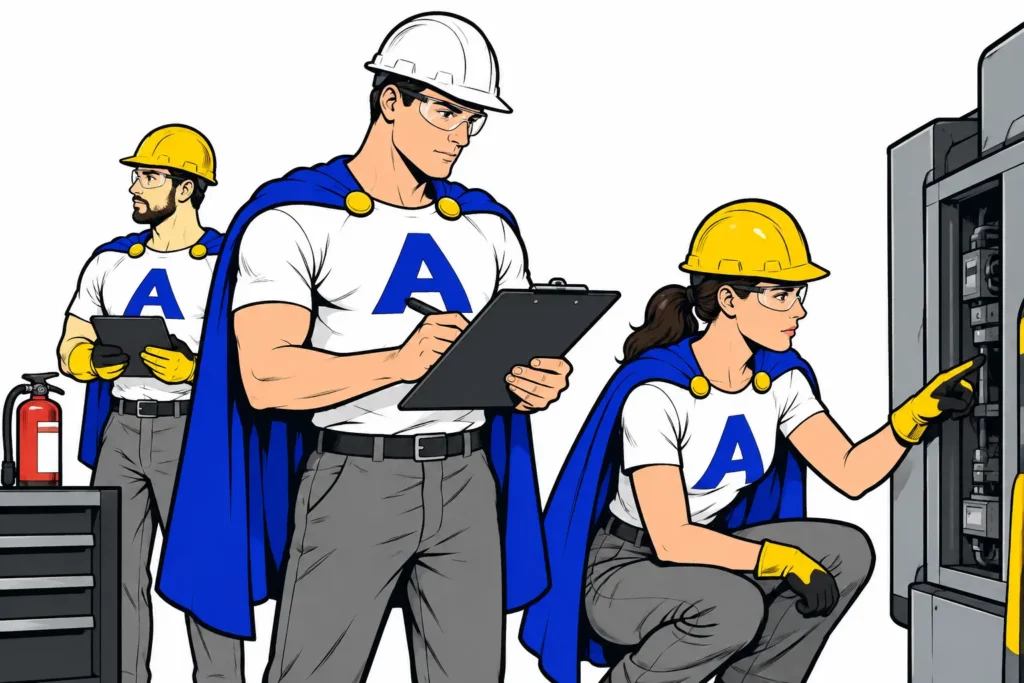
The most effective process is straightforward, but it needs ownership. Captain Safety typically helps employers move from site review to corrective work and ongoing review in three connected stages.
First, inspect the workplace against the actual work being done. Walk the full site, speak to employees and supervisors, and compare conditions with the existing risk assessment, operating instructions and training records. Do not inspect only the areas prepared for visitors. The loading bay at peak delivery time may reveal more than an empty warehouse aisle.
Second, record findings precisely. A useful finding states the location, the hazard, who may be affected, the required corrective action, the responsible person and a target date. Photographs can help where they clarify the issue. Avoid vague entries such as “improve housekeeping”. State what must be removed, stored or marked, and by when.
Third, close the action and verify the result. A corrective action is not complete when someone says it has been done. Check that the guard is fitted, the route is clear, the training has been delivered or the electrical test record is available. Then update the risk assessment if the finding reveals a change in risk or control measures.
This is where many businesses lose momentum. The inspection report exists, but actions are distributed across operations, facilities and HR with no single owner. A simple action tracker and regular review with responsible managers can keep small defects from becoming recurring risks.
When an authority inspection or deficiency notice arrives
If the accident insurance institution (Berufsgenossenschaft, or BG) contacts you, respond promptly and methodically. Do not rush to provide documents that have not been checked, and do not assume the issue is limited to the item named in the letter. A notice about missing electrical tests may also expose weak equipment registers, unclear responsibilities or an out-of-date risk assessment.
Start by understanding exactly what information, correction or evidence has been requested and by what date. Review the relevant workplace area, collect available records and identify what is missing. An external occupational safety specialist can help assess the finding, organise the corrective work and prepare a structured response. Whether a particular action is sufficient depends on the facts of the site and the authority’s request, so avoid generic paperwork that does not match real conditions.
If an accident has occurred, preserve relevant information, care for the affected person and follow applicable reporting duties. Use the event to examine underlying causes as well as the immediate failure. For example, a slip may involve a wet floor, but also poor cleaning arrangements, unsuitable footwear requirements, weak supervision or inadequate reporting of leaks.
Who should be involved
Workplace inspections work best when safety is not isolated with one person or department. Managers know operational pressures, employees see practical hazards and facilities teams often control repairs. The company doctor (Betriebsarzt) can contribute where occupational health risks, work capability or preventive medical care are relevant.
For employers with multiple German sites, a consistent inspection framework is useful, but it should not erase local differences. A standard checklist can provide a baseline, while site-specific sections address actual processes, equipment and building conditions. This balance makes records easier to manage without turning inspections into a tick-box exercise.
A practical starting point
If you are unsure what inspections apply, begin with an up-to-date list of sites, work activities, equipment, hazardous substances and responsible people. Compare that list with your risk assessments, inspection records, training evidence and outstanding actions. Missing records are not always proof that a check was missed, but they are a warning sign that you may not be able to demonstrate control.
You do not need to solve every issue in one week. Prioritise immediate danger first, then legal deadlines and recurring risks. With qualified support, clear records and people who own each action, workplace inspections become a practical habit that protects your team and gives you a firmer footing when questions arise. If a new site, BG letter or inspection deadline has put safety on your agenda, requesting a quote for structured support is a sensible next step.