
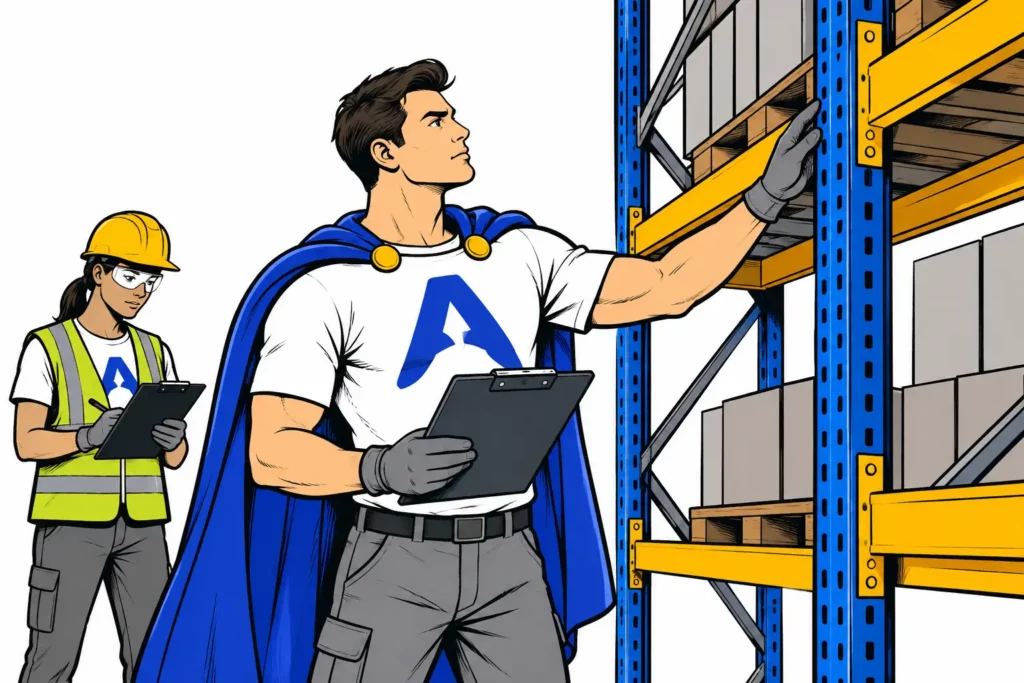
A bent upright, a missing beam lock or a forklift impact can turn an ordinary warehouse aisle into a serious risk. If you are asking when is racking inspection required, the short answer is: throughout the working life of your storage racking, not only after something goes wrong. German requirements combine regular internal checks with periodic expert inspections, supported by a documented risk assessment (Gefährdungsbeurteilung).
For employers, the practical task is to set an inspection routine that reflects the racking system, the loads stored, forklift traffic and the likelihood of impact damage. A reliable routine protects employees, helps prevent stock loss and gives you evidence that you are managing a known workplace risk.
When is racking inspection required?
Storage racking must be inspected before it is put into service where assembly, installation or operating conditions can affect safe use. It must then be checked at regular intervals during use. The Industrial Safety Regulation (Betriebssicherheitsverordnung, BetrSichV) requires employers to determine suitable inspection measures and intervals through their risk assessment.
For most pallet racking and similar fixed steel storage systems, recognised practice under DGUV 208-043 and DIN EN 15635 is built around two levels of inspection. A trained member of staff carries out regular visual inspections, usually at least weekly. In addition, a qualified person (befähigte Person) carries out a detailed expert inspection at least once every 12 months.
The annual inspection is not a substitute for weekly checks. Weekly inspections are intended to spot new damage before it worsens. The annual inspection examines the racking more systematically, including structural condition, safe configuration, protection measures and whether identified defects have been properly controlled.
Your risk assessment may justify more frequent checks. This is common where forklifts operate in narrow aisles, loads are heavy or frequently moved, the warehouse has high throughput, or prior impact damage is common. A low-use archive area and a busy distribution centre should not necessarily have the same inspection plan.
Events that require an additional inspection
Do not wait for the next scheduled date if something changes or damage is suspected. Racking should be assessed promptly after a forklift collision, fallen load, overloading event or other incident that could affect stability. The same applies after an accident involving the racking or a near miss that reveals a credible structural risk.
An additional inspection is also appropriate after alterations. Examples include moving the racking, changing beam levels, replacing components, extending an installation, changing the load type or increasing permitted loads. A rack that was safe for one configuration may no longer be safe after an apparently simple change.
If an employee reports a leaning frame, damaged upright, dislodged safety lock, loose anchor or visible deformation, isolate the affected area where necessary and arrange assessment. Continuing to load a visibly damaged bay because operations are busy is a poor trade-off. It may place people at risk and make a manageable repair into a major failure.
What weekly visual inspections involve
Weekly visual inspections should be assigned to a trained person who understands the racking layout, common failure points and the site’s damage-reporting process. This can be a warehouse supervisor or another suitable employee. They need enough authority to act when they find a problem.
The check is normally visual and practical rather than a technical engineering assessment. The inspector looks for fresh impact damage, bent uprights or beams, missing beam safety locks, damaged bracing, loose or missing floor anchors, unstable loads and obstructions in aisles. They should also notice whether rack protection is damaged or whether pallets are being stored beyond marked limits.
Keep a clear record of the check, including the date, inspector, areas checked, defects found and action taken. A simple log is useful only when it leads to action. If damage is repeatedly noted but no repair, unloading or escalation follows, the document will not demonstrate effective control.
What happens during the annual expert inspection
The annual expert inspection is more detailed and should be performed by a person with appropriate technical knowledge, practical experience and familiarity with the racking type. In German practice, this is commonly the qualified person referred to in the BetrSichV framework.
The inspection should assess the structural condition of the installation and whether it remains suitable for its actual use. This includes damage to uprights, beams, bracing and anchors, as well as load signs, beam locks, aisle clearance, impact protection and changes made since the previous inspection. The inspector should also review whether earlier defects were rectified appropriately.
You should receive written findings that identify defects, their urgency and recommended corrective measures. Keep these records with your risk assessment, inspection schedule, repair evidence and employee training records. If the accident insurance institution (Berufsgenossenschaft, or BG) visits following an incident or during a workplace review, this documentation helps show how you manage the risk in practice.
Who is responsible for racking safety?
The legal responsibility remains with the employer. You can appoint employees to complete weekly checks and bring in external expertise for annual inspections, but you still need to make sure the system exists, inspections happen and defects are addressed.
The person undertaking the annual inspection must be genuinely qualified for the task. Being generally experienced in warehousing is not automatically enough. The required competence depends on the racking system, the inspection scope and the risks at your site.
Your occupational safety specialist (Fachkraft für Arbeitssicherheit, or SiFa) can support the wider safety process, particularly the risk assessment, responsibilities, documentation and employee instruction. However, the safety specialist is not automatically the right person to carry out every detailed racking inspection. Check competence rather than assuming that a job title covers the requirement.
Managing defects without disrupting operations unnecessarily
Not every defect calls for the same response. A sound system distinguishes between minor issues that can be monitored, defects needing prompt repair and serious damage requiring immediate action. The response should follow the inspection findings and the manufacturer’s instructions.
Where there is a risk to stability, the affected bay should be unloaded and taken out of use until it has been assessed and made safe. Marking it clearly is sensible, but a sign alone is not a control if employees can still load it during a busy shift. Make the physical restriction and communication clear.
Repairs should use suitable components and should not involve improvised straightening, welding or alterations unless authorised by the manufacturer or a competent specialist. The aim is not simply to make the rack look acceptable. It is to restore its safe load-bearing condition.
A practical inspection process for your site
A workable compliance process usually has three stages:
- Assess the installation. Identify every racking area, its intended load, traffic routes, likely damage sources and existing safeguards. Record the result in the risk assessment.
- Set responsibilities and intervals. Nominate trained staff for visual checks, establish a defect-reporting route and schedule the expert inspection. Increase the frequency where operational risk calls for it.
- Correct and document. Prioritise defects, isolate unsafe areas, arrange repairs and retain evidence of what was done. Review the process after major changes, incidents or recurring damage.
This approach is especially valuable when opening a new German warehouse, taking over an existing facility or scaling logistics operations quickly. It creates a repeatable control rather than a last-minute response to a BG notice.
Frequently asked questions
Is an annual racking inspection always required?
For fixed storage racking, an annual expert inspection is the recognised minimum practice under DGUV 208-043 and DIN EN 15635. The precise inspection regime should be defined through your risk assessment under the BetrSichV. In higher-risk operations, annual inspection alone will not be enough because regular visual checks are also expected.
Does every warehouse need weekly racking checks?
Weekly visual inspections are the normal benchmark for racking in active use. Your site may need more frequent checks where forklift impacts, high throughput or intensive loading create greater risk. The key question is whether your chosen interval can identify damage before it creates danger.
Do we need inspection records if no damage is found?
Yes. A record showing that a check took place, even where no defects were identified, supports your inspection system. Keep the records consistently and make sure employees know how to report damage between formal checks.
Racking safety is most effective when it becomes an ordinary part of warehouse control: inspect early, act on damage and keep decisions documented. If you need help setting up the process or responding to identified defects, Captain Safety can bring the right health and safety expertise into your operation without leaving you to interpret the requirements alone.