
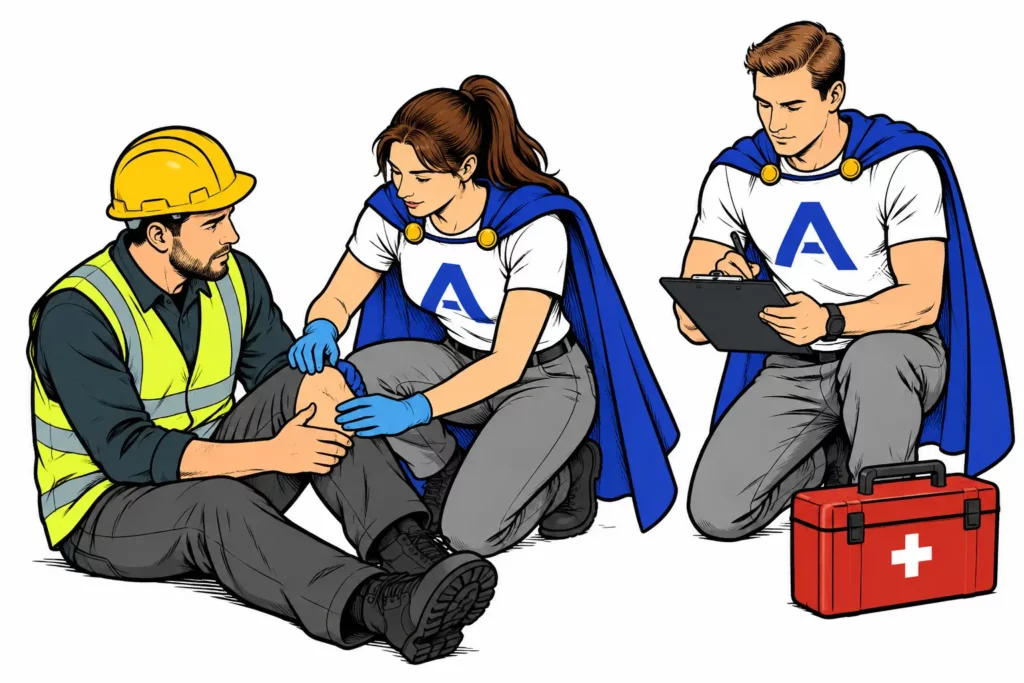
A warehouse operative slips while unloading a lorry. A colleague cuts their hand in the staff kitchen. A developer is injured cycling to the office. These events may look very different, but workplace accident reporting in Germany follows a defined legal process. Your response in the first hours affects the employee’s care, your documentation and your ability to prevent the same event happening again.
For employers operating in Germany, the key is to separate three duties that are often confused: provide first aid, document every relevant incident, and submit a formal accident report when the reporting threshold is met. A formal report is not an admission of fault. It is part of the statutory accident insurance system and a practical starting point for corrective action.
When is a workplace accident report required in Germany?
An employer must report an occupational accident to the relevant accident insurance institution (Berufsgenossenschaft, or BG) when the injured person is unable to work for more than three calendar days. The day of the accident itself does not count towards those three days.
The report is also required where an accident causes death. In that situation, do not wait for the usual process. Notify the BG immediately and follow any instructions from the responsible bodies. Serious events can also trigger contact with the competent occupational safety authority, particularly where the site, equipment or work process needs urgent examination.
The statutory basis sits within the German social accident insurance framework, while your wider prevention duties arise under the Occupational Health and Safety Act (Arbeitsschutzgesetz, ArbSchG). In practice, the accident insurance institution will expect a clear account of what happened, who was involved and what you have done to prevent recurrence.
A commuting accident can also be covered by statutory accident insurance when it occurs on the direct route between home and work. The facts matter. A substantial private detour may change the position, so record the circumstances carefully rather than assuming every journey-related incident is reportable.
First aid records come before formal reporting
Not every injury leads to time away from work, but that does not make it irrelevant. First-aid treatment must be recorded in the first-aid documentation. This includes minor cuts, bruises and other incidents where a trained first aider provides treatment, even if the employee returns to work immediately.
These records are more than a logbook. They establish what happened, what treatment was given and when. They can be essential if symptoms worsen later or if an employee makes an insurance claim. First-aid records must generally be retained for five years.
Your workplace should have trained first aiders, suitable first-aid equipment and a clear route for employees to report injuries promptly. In a dispersed business, that may mean different arrangements for an office, a retail unit and a warehouse. One policy copied across every location is rarely enough.
Where medical treatment may be needed, make sure the employee understands that it is a work-related accident. Depending on the injury and expected absence, treatment through an accident insurance doctor may be appropriate. The treating medical professional can help direct the employee through the correct route.
What the accident report should contain
The formal accident report should be factual, timely and consistent with your internal records. Do not speculate about blame or use vague wording such as “carelessness” where the underlying facts are unclear.
Record the employee’s details, the date, time and location, the activity being carried out, the sequence of events, the injury and any witnesses. Include the first-aid measures taken and identify the person preparing the report. If there is an employee representative body, provide it with the required copy of the report.
The description should help someone who was not present understand the event. “Employee fell” is not enough. “Employee stepped backwards from the picking platform while handling an oversized carton, caught their foot on unsecured stretch-wrap and fell to the floor” is more useful because it points towards conditions worth investigating.
Submit the report to the relevant BG within three days of learning that the reporting threshold has been met. Many institutions provide their own online reporting route or form. Your company may belong to a different BG from a neighbouring business, but the employer’s duty remains the same.
Preserve facts, then investigate causes
Once the immediate situation is under control, preserve the evidence. Take photographs of the area where appropriate, secure damaged equipment and retain relevant work instructions, inspection records and training evidence. Speak to witnesses separately while memories are fresh.
Then look beyond the last action taken by the injured person. A proper investigation asks why the conditions allowed the incident to happen. Was the floor layout poorly maintained? Was the task rushed because staffing was inadequate? Had a lifting aid not been inspected? Was the employee trained, supervised and given instructions they could realistically follow?
This is where a risk assessment (Gefährdungsbeurteilung) becomes a working management tool rather than a document stored in a folder. Update the assessment when the accident exposes a hazard that was missed, underestimated or not effectively controlled.
There is a useful distinction here. An employee may have made an error, yet the employer may still need to improve the system around the task. Safe work depends on practical training, workable processes, appropriate equipment and supervision. Blaming an individual too early often leaves the real cause in place.
Turn the report into corrective action
The most valuable part of workplace accident reporting in Germany happens after the form is submitted. Translate findings into actions with named owners and dates, then check whether the changes work in practice.
For a warehouse incident, corrective action might involve repairing racking protection, reviewing pedestrian routes, refreshing manual-handling instruction and arranging the required inspection of work equipment. For an office incident, it may mean improving cable management, adjusting cleaning arrangements or reviewing display screen workstations. The right response depends on the activity and the risk, not on a generic checklist.
Where technical, organisational or health factors are involved, involve the right people. An occupational safety specialist (Fachkraft für Arbeitssicherheit, or SiFa) can review hazards, controls and documentation. A company doctor (Betriebsarzt) can advise where work-related health effects, rehabilitation or return-to-work questions arise. Managers remain responsible for implementing the agreed measures.
If the accident reveals a wider issue, consider whether other records need updating too. That can include operating instructions, employee training records, hazardous substance controls, fire safety arrangements or equipment inspection schedules under applicable rules such as DGUV V3 and BetrSichV.
A practical three-step response
1. Protect people and record the event
Provide first aid, obtain medical support where needed and secure the area if there is an ongoing danger. Record the event in first-aid documentation, collect initial facts and make sure the injured person knows how to access appropriate treatment.
2. Check the reporting threshold
Confirm whether absence exceeds three calendar days, whether the accident was fatal or whether another urgent notification is necessary. Submit the accident report to the responsible BG within the applicable timeframe and keep a copy with your internal file.
3. Correct the conditions that caused harm
Investigate proportionately, update the risk assessment and implement controls. Assign responsibility, communicate changes to affected employees and verify that the corrective action is actually being followed on site.
Common reporting mistakes to avoid
The most common mistake is waiting until an employee has been absent for several days before gathering facts. By then, CCTV may have overwritten, equipment may have been moved and witness accounts may be less reliable. Start documenting on the day of the incident, even if it is not yet clear whether formal reporting will be required.
Another mistake is treating the report as the end of the matter. Accident insurance institutions may ask what preventive measures you have taken, especially after a serious event or repeat incident. A concise action plan supported by current assessments, training and inspection evidence puts you in a much stronger position than a form alone.
Finally, avoid assuming that a small team has small duties. The scale and frequency of occupational safety support may vary, but employers still need appropriate first aid, risk assessments, training, documentation and competent advice.
When external support helps
If you have received a request from your BG, need to report a serious incident, or are unsure whether your current records are sufficient, bring in competent support early. Captain Safety can help employers investigate the event, structure the documentation, update risk assessments and organise the corrective work that follows.
The aim is not to create paperwork for its own sake. It is to make the next shift safer than the one in which the accident happened. That is the most practical form of prevention, and the kind of safety work your people will notice.