
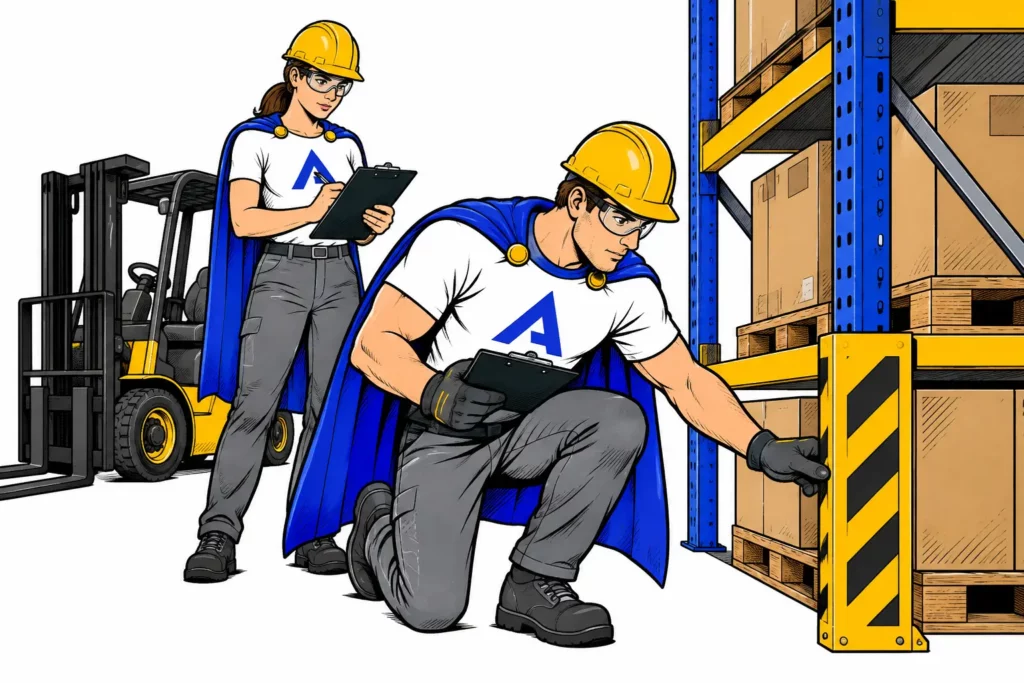
A warehouse can look orderly at 08:00 and still contain the conditions for a serious injury by lunchtime. A damaged pallet beam, a pedestrian cutting across a forklift route, or a blocked fire door can turn routine work into an incident quickly. Essential warehouse safety checks give you a practical way to find those conditions early, assign corrective action and show that safety is being managed rather than assumed.
For employers in Germany, these checks are not simply good operations practice. The Occupational Health and Safety Act (Arbeitsschutzgesetz, ArbSchG) requires you to assess workplace risks and take suitable protective measures. What is suitable depends on your site, equipment, workforce and processes. A small storage area with hand pallet lorries needs a different approach from a high-bay fulfilment centre operating several shifts.
Start with the risk assessment
Your risk assessment (Gefährdungsbeurteilung) is the working basis for warehouse safety. It should cover the real tasks people perform, not just reproduce a generic checklist. Walk the site during normal activity and speak with employees who receive goods, pick orders, load vehicles, clean aisles and operate equipment.
Look at traffic, storage, lifting, working at height, loading bays, electrical equipment, fire risks, hazardous substances and lone working where relevant. Also consider less obvious pressure points: seasonal volumes, agency staff, altered shift patterns, temporary storage in aisles and new packaging formats.
The assessment should identify who may be harmed, what controls are already in place, where they fall short, and who is responsible for each action. Review it when the warehouse changes, after an accident or near miss, and at appropriate intervals. Documentation matters, but the purpose is action on the floor.
Essential warehouse safety checks for every shift
A short pre-use check is one of the most useful controls in a busy warehouse. It catches faults before someone relies on equipment or enters an unsafe area. Supervisors should make clear that reporting a defect is expected behaviour, not a reason for blame.
Check traffic routes and loading areas
Separate pedestrians from forklift traffic wherever reasonably practicable. Mark routes clearly, keep crossings visible and make sure barriers, mirrors and warning signs remain in place. Painted lines alone may not be enough where visibility is poor, traffic is frequent or pedestrians have no alternative route.
At loading bays, check dock edges, wheel restraints, levellers, lighting and communication arrangements between warehouse staff and drivers. A lorry must not move while people or equipment are entering or leaving its loading area. Wet floors, loose stretch wrap and uneven surfaces deserve quick attention because they create both slip and vehicle-control risks.
Inspect forklifts and other work equipment
Industrial lorries, pallet lorries, conveyors, wrapping machines and lifting aids need pre-use checks appropriate to the equipment. For forklifts, this commonly includes tyres, forks, chains, steering, brakes, lights, horn, warning devices and visible leaks. Defective equipment must be removed from use until it is made safe.
Pre-use checks do not replace statutory inspection. The Ordinance on Industrial Safety and Health (BetrSichV) requires employers to ensure work equipment is safe, maintained and inspected by competent persons where required. Keep inspection evidence organised and readily available. If an accident insurance institution (Berufsgenossenschaft, or BG) visits, incomplete records can make an otherwise manageable issue harder to explain.
Examine racking before damage worsens
Racking is often treated as fixed infrastructure, even though it is exposed to repeated impacts. Check upright frames, beams, braces, base plates, pallet supports and protection barriers for visible damage, missing parts, distortion or overloading. Look for pallets that are broken, badly stacked or projecting into aisles.
Warehouse racking should have a routine visual inspection process, with reported damage assessed and dealt with promptly. Formal racking inspections should also be planned in line with the applicable requirements and DGUV 208-043. The right response depends on the severity of damage. Some defects require immediate unloading and isolation, while others may be managed through a defined repair process. Do not leave that judgement to an untrained employee under time pressure.
Keep emergency protection usable
Fire safety is tested in the small details. Check that escape routes, emergency exits, fire doors, extinguishers, call points and electrical distribution areas are not blocked by stock, cages or waste. Emergency lighting and signs must remain visible, including during temporary changes to storage layouts.
Warehouses often accumulate combustible packaging quickly. Remove waste regularly, control battery charging areas and store flammable substances according to their hazards. If your site uses chemicals, your hazardous substances management must be supported by a hazardous substances risk assessment under the Hazardous Substances Ordinance (Gefahrstoffverordnung, GefStoffV). Safety data sheets, storage rules, labelling and employee instruction should match what is actually present.
Check people, not only premises
A safe warehouse depends on competent people making consistent decisions. Confirm that forklift operators have the required training and authorisation for the equipment they use, and that new starters understand local traffic rules, emergency arrangements and reporting routes before working alone.
Training must be understandable to the workforce. If your team uses several languages, use practical demonstrations, visuals and confirmation of understanding rather than relying on a signed attendance sheet. Refresher instruction is particularly valuable after layout changes, incidents, long absences or a rise in unsafe observations.
You should also check whether supervisors know what authority they have to stop unsafe work. Production targets do not remove an employer’s safety duties. Clear escalation routes help people act early when a rack is struck, a forklift develops a fault or an exit is blocked.
Assign competent support and keep evidence ready
German employers must appoint appropriate occupational health and safety support. Depending on your circumstances, this includes an occupational safety specialist (Fachkraft für Arbeitssicherheit, or SiFa) and a company doctor (Betriebsarzt). Their role is to advise on hazards, preventative measures, workplace conditions and the health impact of work. They do not take legal responsibility away from the employer, but they give you the specialist basis to meet it properly.
The frequency and scope of support are shaped by DGUV Regulation 2 and your business circumstances. A growing operation, a new warehouse or a site following an incident may need more attention than a stable, low-risk office location. This is where an external specialist can bring structure without requiring a full in-house HSE function.
Keep your evidence practical and current: risk assessments, inspection records, maintenance logs, training records, operating instructions, accident documentation and meeting minutes. A safety committee meeting may be required depending on workforce size and should be used to resolve actual site issues, not merely complete paperwork.
A three-step way to regain control
If you are opening a site, responding to a BG letter or finding gaps in your records, start with an on-site review. This establishes what is happening in the warehouse and which legal and operational issues need priority.
Next, turn findings into a corrective action plan. Allocate owners, deadlines and interim controls. A damaged rack or unsafe charging area may need immediate protection, while a revised traffic plan may need consultation, signage and employee instruction.
Finally, build the checks into normal management. Regular reviews, statutory inspections and targeted training are more reliable than a rushed clean-up before an external visit. Captain Safety can support this process across Germany, from the first inspection through corrective actions and ongoing review.
When does a warehouse need a formal inspection?
Formal inspections are required for various types of work equipment and installations, with intervals based on risk and legal requirements. Racking needs organised inspections, while forklifts, electrical equipment and lifting equipment each have their own maintenance and inspection expectations. Do not assume that a supplier service visit covers every statutory duty.
What should happen after a near miss?
Record the event, secure the immediate hazard and investigate what allowed it to happen. A near miss involving a pedestrian and forklift may reveal poor route design, inadequate visibility, rushed work or unclear rules. Correct the underlying causes and communicate the learning to affected staff.
A good warehouse check is not a hunt for blame or a binder full of forms. It is a routine habit of noticing risk before it hurts someone. Give your team the time, authority and expert support to act on what they find, and safety becomes a visible part of how the warehouse works.